
Ok

Ok

What is the question
Cancel
PICTURE FRAMES
 CUSTOM PICTURE FRAMES
CUSTOM PICTURE FRAMES
Design Your Framing Package Online!
Add Mats, Glass & Acrylic, Mounting Board And More.




Search
☰

My Account
Log In
Favorites
Saved Designs
Shopping Cart

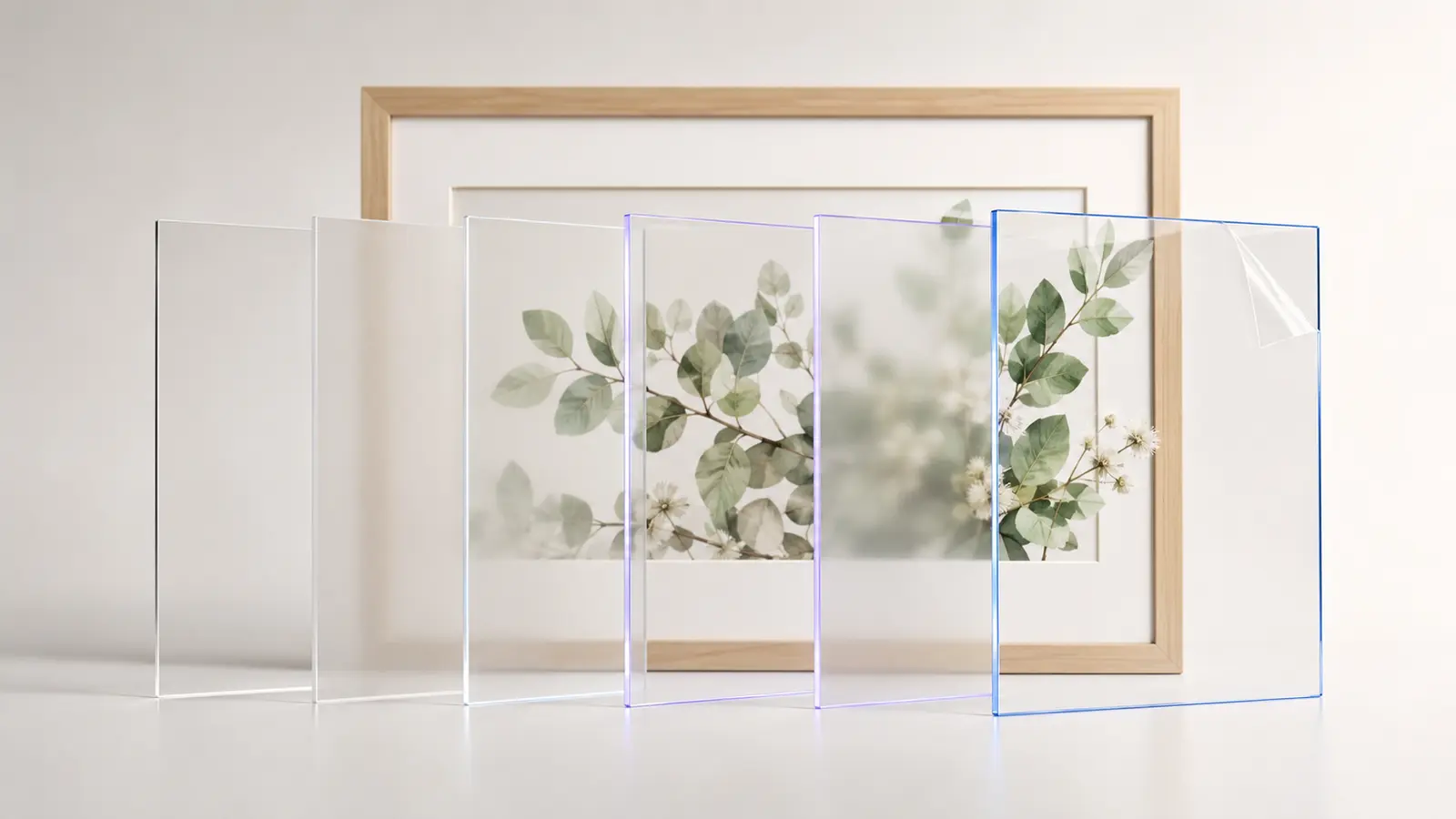
Acrylic glazing is the clear protective sheet placed in front of artwork. WebPictureFrames.com offers five choices with different levels of glare control, UV filtering, static control, and abrasion resistance. This guide compares each option so you can match the glazing to your artwork, display environment, and budget.
1. Why Acrylic Glazing Choice Matters
Acrylic glazing is more than a protective cover. It influences how clearly you see the artwork, how much reflected light is visible, the level of UV filtering, and how safely the finished frame can be handled or shipped. Browse all choices in our Glass & Acrylic Glazing collection.
- Protects artwork from dust, fingerprints, and moisture.
- Offers approximately 90 percent UV filtering in FF3 and P99, or conservation-level UV filtering in OP3, OP3 P99, and Optium.
- Controls distracting light with a non-glare surface or premium anti-reflective coatings.
- Keeps frames lightweight and safer for large sizes.
- Reduces risk of breakage during shipping.
2. Acrylic Versus Glass In Picture Framing
Both acrylic and traditional glass are used in picture frames, but each behaves differently.
| Feature | Acrylic Glazing | Glass Glazing |
|---|---|---|
| Weight | Lightweight and well suited to large wood or metal frames. | Heavy and more difficult to hang in larger sizes. |
| Impact resistance | Shatter resistant. Excellent for frames shipped nationwide. | Can break into sharp pieces. |
| Clarity | Excellent clarity; available with non-glare or anti-reflective viewing options. | Glass may show green tint depending on thickness. |
| Scratch resistance | Requires careful cleaning; Optium adds an abrasion-resistant hard coat. | More resistant to small scratches. |
| UV protection | Every option provides some UV filtering; OP3, OP3 P99, and Optium are intended for conservation framing. | Available in UV glass varieties. |
Acrylic is generally the safer choice for shipped frames, large-format work, schools, offices, and other settings where broken glass is a concern. Glass remains naturally more resistant to everyday scratching.
3. Compare All Five Acrylic Options
The terms non-glare and anti-reflective do not mean the same thing. Non-glare P99 acrylic uses a finely textured surface to diffuse reflections. Optium Museum Acrylic uses optical coatings to reduce reflections while preserving sharp detail and color.
| Acrylic | Viewing Surface | UV Performance | Best For |
|---|---|---|---|
| ACRYLITE FF3 Clear Acrylic | Clear, glossy | Approximately 90 percent UV filtering from 200 to 390 nm | Posters, prints, photos, large frames, and everyday framing |
| ACRYLITE P99 Non-Glare Acrylic | One-sided matte surface diffuses glare | Approximately 90 percent UV filtering from 200 to 390 nm | Artwork displayed opposite windows or bright room lights |
| ACRYLITE OP3 UV-Filtering Acrylic | Clear, glossy | Nearly complete UV filtering; nearly 100 percent at 390 nm | Photos, limited editions, documents, and valuable art needing clear conservation glazing |
| ACRYLITE OP3 P99 UV Non-Glare Acrylic | One-sided matte surface diffuses glare | Nearly complete UV filtering | Conservation framing in rooms with difficult reflections |
| Tru Vue Optium Museum Acrylic | Double-sided anti-reflective optical coating | Blocks 99 percent of UV rays from 300 to 380 nm | Museum-quality presentation, valuable originals, deep shadow boxes, textiles, and works sensitive to static |
Our premium recommendation: Choose Tru Vue Optium Museum Acrylic when the best possible viewing experience and preservation features matter. It provides more than 98 percent light transmission, less than 1.5 percent reflection, 99 percent UV blocking, anti-static performance, and an abrasion-resistant surface.
4. Glare, UV Protection, Static, And Cleaning
4.1 Clear, Non-Glare, Or Anti-Reflective
Choose clear FF3 or OP3 when crisp detail is the priority and reflections can be controlled by placement. Choose P99 or OP3 P99 to soften reflections from windows and lights. Because the matte surface can slightly soften fine detail, keep the acrylic close to the artwork and install the textured side facing the viewer. Choose Optium when you want minimal reflections without the diffused appearance of a non-glare surface.
4.2 UV Filtering And Conservation Framing
No glazing can prevent every form of fading. Heat, visible light, humidity, materials, and display time also matter. FF3 and P99 provide useful UV filtering for general framing. For valuable, sentimental, or irreplaceable items, select OP3, OP3 P99, or Optium and avoid direct sunlight.
4.3 Size, Weight, And Hanging
Acrylic is lightweight, making it ideal for large formats and for frames built with:
4.4 Durability, Static, And Cleaning
FF3, P99, OP3, and OP3 P99 can attract dust through static and should be cleaned with an acrylic-safe product and a clean microfiber cloth. Our Acrylic Cleaning and Polishing Kit is intended for these conventional acrylic sheets.
Optium immediately dissipates static and offers substantially better resistance to minor scratches than uncoated acrylic. Clean Optium according to its product instructions with a clean, soft, lint-free cloth and a compatible glass cleaner. Do not use acrylic cleaner or acrylic polishing compounds on Optium's coated surface.
4.5 Budget And Value
FF3 is the value choice for everyday framing. P99 adds economical glare control. OP3 and OP3 P99 add conservation-level UV filtering. Optium costs more because it combines premium anti-reflective clarity, conservation UV protection, anti-static performance, and abrasion resistance in one lightweight sheet.
5. How To Choose Acrylic For Your Frame
- Identify the artwork and its value. Use FF3 or P99 for replaceable decor and general framing. For originals, heirlooms, limited editions, textiles, or other light-sensitive objects, start with OP3, OP3 P99, or Optium.
- Evaluate the display environment. Note windows, lamps, viewing angles, and the distance between the artwork and glazing. Choose P99 or OP3 P99 for economical glare diffusion, or Optium for premium anti-reflective clarity.
- Select the performance level. Match the need for UV filtering, reflection control, static control, and scratch resistance to the comparison table above.
- Confirm the frame package will fit. Check that the frame rabbet accommodates the acrylic, mat or spacers, artwork, and backing. Keep artwork from touching the glazing.
- Install and maintain it correctly. Leave the protective masking in place until final assembly, handle the sheet by its edges, and follow the cleaning directions for the specific product.
6. Quick Reference: Which Acrylic Glazing Should I Pick?
| Situation | Recommended Acrylic Glazing |
|---|---|
| Everyday posters, prints, and large artwork | ACRYLITE FF3 Clear Acrylic |
| Everyday art with distracting room reflections | ACRYLITE P99 Non-Glare Acrylic |
| Valuable art needing clear conservation glazing | ACRYLITE OP3 UV-Filtering Acrylic |
| Valuable art needing UV and glare control | ACRYLITE OP3 P99 UV Non-Glare Acrylic |
| Best clarity, conservation, anti-static, and abrasion resistance | Tru Vue Optium Museum Acrylic |
7. Common Glazing Mistakes To Avoid
- Assuming non-glare and anti-reflective acrylic provide the same viewing experience.
- Selecting P99 for glare control when the artwork also needs the stronger UV filtering of OP3 P99.
- Displaying valuable artwork in direct sunlight even when UV-filtering glazing is installed.
- Installing one-sided P99 with the textured side facing the artwork instead of the viewer.
- Allowing artwork to touch the glazing instead of using a mat or frame spacers.
- Using acrylic polish on Optium or using abrasive and incompatible cleaners on conventional acrylic.
8. Frequently Asked Questions About Acrylic Glazing
Does acrylic glazing yellow?
Quality framing acrylic is designed for long-term optical clarity and resistance to yellowing. Proper display and care still matter.
Is acrylic safe for shipped frames?
Yes. It is shatter-resistant and ideal for shipping large frames.
Is non-glare acrylic the same as anti-reflective acrylic?
No. P99 non-glare acrylic diffuses reflections with a matte texture. Optium reduces reflections with optical coatings and maintains a sharper view of fine detail.
Does UV-filtering acrylic stop all fading?
No glazing can stop all fading. UV-filtering acrylic reduces a major source of damage, but visible light, heat, humidity, display duration, and the materials in the artwork also affect change over time.
Can I clean every acrylic product the same way?
No. Use an acrylic-safe cleaner for FF3, P99, OP3, and OP3 P99. Optium has a coated surface and should be cleaned with a compatible glass cleaner and a soft, lint-free cloth. Do not use acrylic cleaner or polishing compounds on Optium.
Which acrylic is best for valuable artwork?
Tru Vue Optium Museum Acrylic is our most complete option because it combines premium anti-reflective viewing, 99 percent UV blocking, anti-static performance, abrasion resistance, and shatter resistance. OP3 and OP3 P99 are strong conservation choices when budget or the desired surface finish points to a different option.
Made in the USA
Handcrafted by American framing experts
Family Owned
Serving customers for over 40 years
Premium Shipping
Professionally packaged for safe delivery
Ready to Hang
Hardware included with all frames
Framing Specialists
Over 40 years of custom framing experience