
Ok

Ok

What is the question
Cancel
PICTURE FRAMES
 CUSTOM PICTURE FRAMES
CUSTOM PICTURE FRAMES
Design Your Framing Package Online!
Add Mats, Glass & Acrylic, Mounting Board And More.





Search
☰

My Account
Log In
Favorites
Saved Designs
Shopping Cart
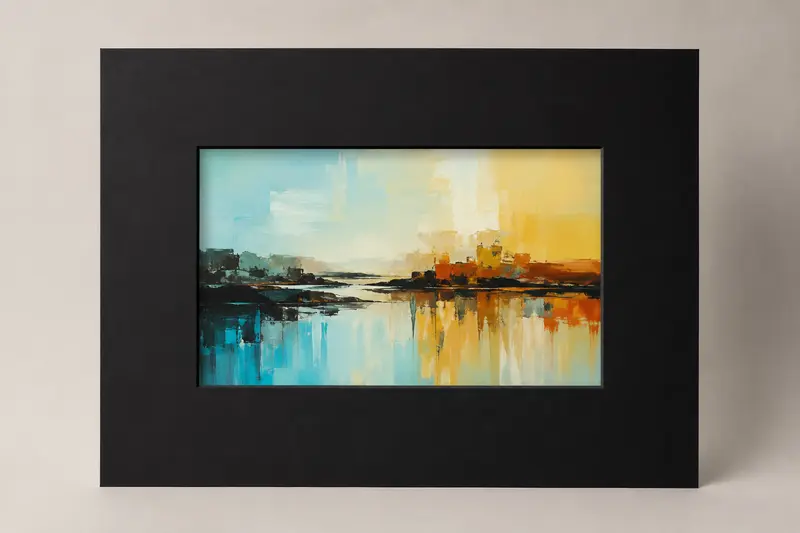
Custom Black Picture Mats
Shop custom black picture mats cut to size. Compare the color value, undertone, surface, core, and thickness, then specify the outside dimensions and opening needed for your artwork and frame.
Shop for Your Primary/Top Mat Color
Choose a black mat to begin your design. It will initially appear as the primary/top mat, creating a strong visual boundary that can make artwork colors feel more vivid.
Shop the black mats below and select a color that complements your artwork.
Use it alone or as the primary/top layer of a double or triple mat.
Add narrow inner accent mats to repeat a color from the artwork, create contrast, or connect the design to the frame.
Your selection is only a starting point. You can change the primary/top mat, colors, dimensions, borders, and layers using our Custom Mat Designer.
Filters
reset filters
SKU

Color Sets
Mat Styles
Material
14 Results
Sort:

5598
Archival
from $7.05
Etched Black

Black mat with a bit of gloss. Deepest black of all mats.




4855
Fabric Tier 2
from $35.62
New Moon Shantung Silk

Black fabric with blue undertones with a shimmering surface





BlkBlkcore
Archival Black Core
from $8.81
Black mat black core

Black mat black core. This is one of only 2 mats with black core on our site.

Black Picture Mats Cut to Your Dimensions
Black picture mats create strong definition around artwork and can visually connect dark details to black, charcoal, or metal frame finishes. Compare smooth, textured, black core, standard 4-ply, and deeper 8-ply choices, then order the outside size and opening your artwork and frame require.
Every mat is cut to the measurements selected during ordering. Choose the outside size that fits the frame and the opening that controls how much artwork remains visible. Single, double, and triple mat designs can use black as the primary border or as a controlled inner accent.
Rich Solid Blacks
Deep black surfaces create the strongest contrast and a bold, graphic border around photography, posters, prints, and contemporary artwork.
Soft and Charcoal Blacks
Softer blacks reduce the severity of the contrast and can relate naturally to graphite, charcoal, muted photography, and weathered frame finishes.
Black Core Mats
A black core remains visible at the beveled opening, keeping the edge dark instead of exposing a white bevel.
White Core Black Mats
A black surface over a light core produces a visible pale bevel that outlines the opening and separates the mat from dark artwork.
Textured Black Mats
Suede, linen, silk, and other textured surfaces add depth and absorb or reflect light differently from smooth mat board.
Deep-Bevel Black Mats
8-ply construction creates a deeper cut edge and stronger dimensional transition between the mat surface and artwork.
How to Choose a Black Mat Shade
Black has substantial visual weight. Compare how much border will be visible, whether the artwork contains enough dark value to connect with it, and whether a white or black bevel should define the opening. A narrow colored inner mat can soften the transition.
View the choice as part of the complete design: artwork, mat or layered mats, frame finish, glazing, wall color, and room lighting. Screen previews are useful for narrowing the range, but they cannot provide a dependable final color match.
Best suited for: black-and-white photography, posters, graphic art, certificates, contemporary prints, charcoal drawings, and artwork containing strong dark values.
Compare Custom Black Picture Mat Options
Start with the value and undertone that support the artwork, then compare surface, core, thickness, and preservation level. The color family defines the general direction, but these material differences determine how the finished mat looks and performs.
| Black mat type | Best use | Visual advantage | Important consideration |
|---|---|---|---|
| Solid black | Photography, posters, graphic and contemporary art | Maximum contrast and visual weight | Can overpower delicate or very light artwork |
| Charcoal-black | Graphite, charcoal, and muted images | Softer relationship than a true black | May read as gray beside a saturated black frame |
| Black surface, white core | Designs needing a crisp outline at the opening | Light bevel separates dark mat from artwork | The white bevel is intentionally visible |
| Black core | Photography and modern graphic presentations | Keeps the beveled opening dark | Creates less light separation at the artwork edge |
| Textured black | Portraits, textiles, and dramatic presentations | Adds tactile surface character | Lint, lighting, and texture are best judged from a sample |
| 8-ply black | Fine art needing strong depth and definition | More dimensional bevel | Requires additional frame depth |
How to Size a Custom Black Picture Mat
A correctly sized mat must fit both the artwork and the frame. Treat the outside dimensions and opening dimensions as separate measurements.
- Measure the artwork. Record its exact width and height and note any signature, border, deckled edge, text, or image detail that must remain visible.
- Choose the opening. The opening is normally slightly smaller than the artwork so the mat overlaps and retains its edges.
- Determine the outside size. The outside dimensions should fit the frame opening. Use the stated frame size or measure a mat that already fits.
- Review the border widths. Confirm that the top, sides, and bottom create the balance you want around the visible image.
- Confirm frame depth. Make sure the frame can hold the mat, artwork, glazing, mounting materials, and backing. Layered and 8-ply mats need additional depth.
Do not make the opening exactly equal to the artwork size unless exposed edges are intentional and another mounting method will support the art. A normal mat opening needs enough overlap to keep the artwork behind it.
Before ordering, see how to measure artwork for a custom picture mat for guidance on artwork dimensions, mat openings, and overlap.
Choose the Material, Core, and Mat Layers
Match the Preservation Need
Use archival mat board for photographs, prints, documents, and artwork you want to preserve. Choose museum board for especially valuable, original, historic, or irreplaceable pieces.
Compare Surface and Core
Smooth board keeps attention on the artwork. Fabric adds texture, while white core or black core changes the visible line along the beveled opening.
Add Layers Deliberately
A double or triple mat exposes narrow inner bands. Use those accents to repeat an artwork color, control contrast, or separate the top mat from the image.
Mat colors shown on a monitor are approximate. Order a physical sample when precise color, undertone, surface texture, or core appearance matters.
Picture Mat Guidance and Related Options
Use these resources to compare mat materials and nearby color families or continue building the custom framing package.
Custom Black Picture Mat FAQ
When should I choose a black picture mat?
Black works especially well when the artwork contains strong dark values or needs crisp graphic definition. It is commonly used with photography, posters, certificates, contemporary prints, and charcoal or ink work.
What is the difference between a black mat and a black core mat?
A standard black-surface mat may expose a light-colored core at the bevel. A black core mat keeps the cut edge dark, producing a more continuous black border around the opening.
Will a black mat overpower my artwork?
It can if the border is very wide or the artwork is delicate and pale. Consider the artwork's value range, use a narrower visible border, select a softer charcoal-black, or add a narrow inner mat to control the transition.
Are black picture mats available in archival materials?
Yes. Available black choices may include conservation-quality smooth board, black core board, fabric-covered board, and multiple thicknesses. Confirm the specifications of the individual selection.
Can black mats be used in double or triple mat designs?
Yes. Black can serve as the top mat or as a narrow inner accent. Combining it with white, cream, gray, or an artwork-related color can create clearer separation.
Should I order a black mat sample?
A sample is recommended when the difference among deep black, warm black, charcoal, surface texture, and core color affects the design.
Made in the USA
Handcrafted by American framing experts
Family Owned
Serving customers for over 40 years
Premium Shipping
Professionally packaged for safe delivery
Ready to Hang
Hardware included with all frames
Framing Specialists
Over 40 years of custom framing experience