Ok

Ok

What is the question
Cancel
PICTURE FRAMES
 CUSTOM PICTURE FRAMES
Design Your Framing Package Online!
Add Mats, Glass & Acrylic, Mounting Board And More.




Search
☰

My Account
Log In
Favorites
Saved Designs
Shopping Cart

A fillet adds a narrow decorative moulding inside a mat opening or frame lip. This guide turns over a finished mat to show the craftsmanship and protective build-up behind the visible detail.
Watch: What Is a Picture Frame Fillet?
Where the fillet sits
A decorative wood fillet can tuck beneath the lip of a mat opening. Its narrow face creates a defined inner border. Fillets can also sit inside a frame lip; this arrangement is a fillet fitted into a mat.
This is a separate piece of decorative moulding, not the exposed core of a bevel or a line cut into the mat face. Compare a V-groove if you want a decorative cut rather than added moulding.
What changes when a mat includes a fillet?
| Part of the design | What to check | Why it matters |
|---|---|---|
| Visible fillet | Profile, finish, face width, and mitered corners. | It adds a distinct boundary near the image. |
| Finished opening | The actual visible crop after the fillet is fitted. | A projecting detail can affect margins or a signature. |
| Reverse support | Buildup and attachment for this fitted assembly. | The added depth needs physical support. |
| Artwork separation | The specified barrier construction and contact materials. | Do not assume every loose fillet has the same preparation. |
| Frame fit | Complete package depth and retaining method. | The added component must fit with glazing and backing. |
How a fitted fillet mat is assembled
- The mat opening is cut for the design.
- The fillet lengths are cut and mitered to meet accurately at the corners.
- The pieces are fitted closely beneath the mat opening and attached from the back.
- The reverse is built up to accommodate the added thickness, and this fitted assembly receives barrier tape between the wood detail and artwork.
Inspect the reverse construction as well as the visible front. Those fitting and protection steps help explain why a fillet mat involves more work than a plain cut window. This is an explanation of the shop assembly, not a reason to glue bare decorative wood directly against paper artwork.
Plan the complete design and depth
Judge the fillet with the image, mat face, and outer frame. Its profile adds another border and physical depth. Confirm both the visible image opening and the finished package thickness before choosing the frame.
The barrier construction described belongs to this fitted assembly; do not assume every loose fillet or unrelated product has the same preparation. Ask about the exact materials if framing valuable or sensitive paper.
Use the custom mat designer for available fillet options, or ask our framing team about fitting and depth. See usable rabbet depth when assessing the completed package.
Distinguish a fillet from the main frame
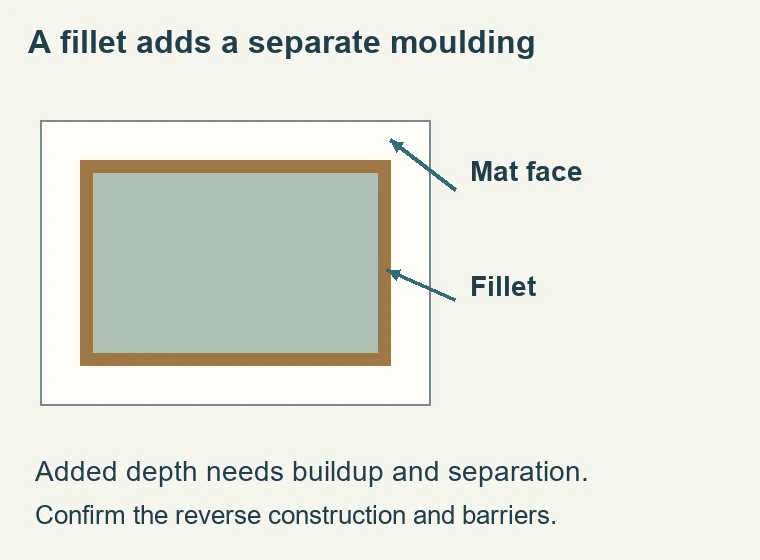
- A fillet is a narrow decorative moulding used as a smaller detail within the framing design. In this arrangement it lines the mat opening, so the viewer sees a small moulded border close to the image while the broad mat and outer frame remain separate. That location gives a small component considerable visual influence. Select it beside the artwork rather than assuming that a narrow face can never become visually prominent.
- Review both the face and reverse of a fitted mat when planning the order and assessing the complete package. They are not a cutting tutorial for an unfamiliar saw or fillet cutter. Accurate small miters and a compatible attachment arrangement require the appropriate tools and instructions. Do not translate a finished sample into guessed machine settings or adhesive specifications.
- The outer moulding still provides the main frame structure. A fillet at the mat window is not a replacement for that structure, and it does not retain the artwork package by itself. Likewise, the mat's supporting buildup and barrier arrangement have their own roles. Keeping those functions distinct helps explain why a fitted fillet mat is more than four small decorative lengths placed loosely around a picture.
Compare the profile with the image and mat
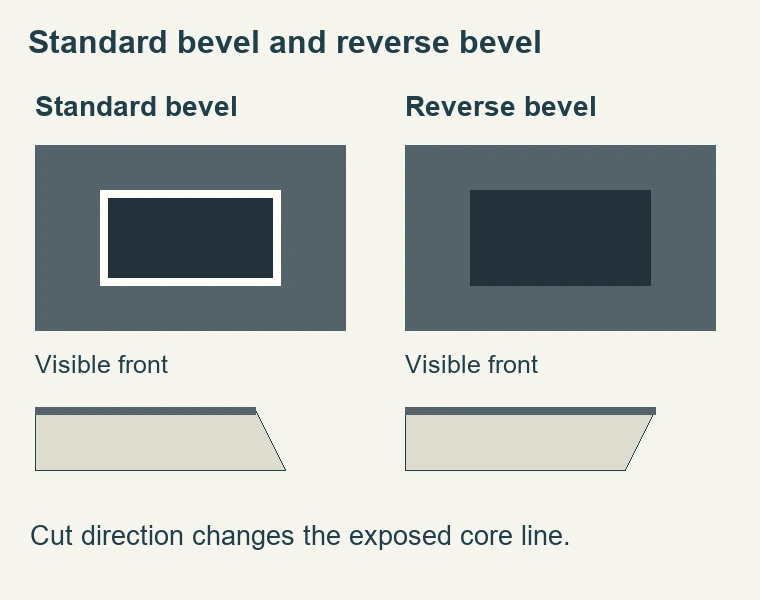
- Look at the fillet's visible width, profile shape, finish, and sheen. A narrow bright edge may be more noticeable than a somewhat wider quiet one. Compare it with fine lines, highlights, and dark areas near the artwork's perimeter. The useful question is whether the detail defines the image or competes with it. There is no requirement that every gold, dark, or shaped outer frame have a matching fillet inside the mat.
- Set a sample against the intended mat face, not only against the outer frame. The same fillet can look different on a warm ivory mat and on a cool dark mat. Its small shadow and raised profile also change how the boundary reads. View it under the intended lighting and step back. A highly detailed close-up can make the carving or finish seem more important than it will be in the room.
- Consider whether the design already has several borders. A double mat, a pronounced bevel, and a decorative outer moulding each add a transition around the image. A fillet can join that sequence, but it should have a purpose within it. Compare a version with fewer details before finalizing the order. Simplifying a competing lower reveal may be more useful than adding another color to connect an overly complex arrangement.
Plan the visible image and the physical opening
- Determine what artwork and paper margin must remain visible before selecting the final opening. A fillet occupies physical space at the inner border, so the visible image cannot be planned as though only a plain mat bevel were present. Confirm the finished viewing opening with the supplier. Do not assume that the nominal mat cutout and the completed visible opening describe the same boundary in every construction.
- For signed prints, inspect the signature, title, and edition number in relation to that finished boundary. A small projecting detail can cover information that appeared safe when only a paper mock-up was used. Test the arrangement with a sample or confirm a measured drawing. Keep the outside mat dimensions, intended image crop, visible fillet face, and other borders separately identified so the order describes the actual finished presentation.
- If you are replacing a plain mat in an existing frame, check both width and depth. The existing frame opening may limit the available broad border, while the added fillet and reverse buildup increase thickness. A design that fits across the front can still require a different retaining arrangement at the back. Do not approve the visible detail before checking whether the complete package can be supported in the existing moulding.
Inspect the supporting and barrier construction
- In the fitted assembly, material is built up around the fillet and barrier tape separates the decorative detail from the artwork. Check those hidden components for the exact service ordered. The visible decorative face alone would not show how the added depth is accommodated or how the wood detail is separated from the artwork. Ask about those hidden details when comparing a finished fillet mat with a loose decorative component.
- Do not assume that any tape placed over wood creates the same barrier arrangement. The exact materials, continuity, and position matter, and a decorative tape is not automatically an artwork-contact material. Use the specified construction or have the framing team assess the project. Avoid bonding bare decorative wood directly to paper artwork simply because the finished sample appears to place the fillet close to the image.
- Verify the board and backing specifications independently of the fillet finish. A wood detail does not establish an archival package, and a pale mat does not prove one either. The supporting sheets, barriers, artwork attachment, and glazing all need appropriate selection. For valuable or sensitive work, explain the artwork and preservation requirements before choosing the decoration so the hidden construction can be planned alongside the visible design.
Check a supplied fillet mat before fitting the artwork
- Confirm that the fillet profile and finish match the selected design.
- Inspect all four miters from the front for a neat, consistent meeting at the corners.
- Check the finished visible opening against the intended artwork crop.
- Inspect the reverse support and specified barrier arrangement without dismantling a supplied assembly.
- Measure the complete package depth with the intended glazing and backing.
- Resolve any loose component, damaged face, or dimensional discrepancy before mounting the artwork.
Handle the assembly by supporting the mat and its added components together. Do not lift it by a narrow projecting fillet or press on the decorative lip to flatten the sheet. Place it on a clean protected surface where the reverse buildup is supported. A small component can be damaged by handling even if its eventual position inside the frame will be well protected.
During fitting, look for a shifted image, an unexpected shadow line, and interference between the reverse construction and backing. The package should seat as planned before retainers are added. Retaining hardware is not a way to force an unsuitable buildup into a shallow frame. If a component catches, identify the contact and revisit the fit rather than tightening the back until the front appears flat.
Questions worth settling with the framing team
- Ask whether the quoted item is a loose fillet, a fillet fitted into a mat, or a detail installed inside a frame lip. Those are different deliverables. Confirm who performs the mitering and attachment, how the artwork is separated from the decorative material, and which dimensions describe the finished visible opening. These questions prevent an attractive sample from being mistaken for a complete ready-to-fit assembly.
- For a future matching piece, record the chosen profile or official product reference with the board and opening dimensions. Preserve official product names and identifiers in the order record where supplied. A description such as 'small dark fillet' is unlikely to communicate the exact shape and finish later. Keep a photograph of the complete front and any supplied construction information so the visual and physical details can be reproduced together.
- If the objective is only a fine line in the mat face, compare a V-groove before choosing a separate moulding. If the objective is a colored band, compare a lower mat reveal. Those alternatives serve different effects and have different construction. Choose the one that fits the desired appearance and package, then specify it accurately rather than treating every small inner border as the same kind of fillet.
Made in the USA
Handcrafted by American framing experts
Family Owned
Serving customers for over 40 years
Premium Shipping
Professionally packaged for safe delivery
Ready to Hang
Hardware included with all frames
Framing Specialists
Over 40 years of custom framing experience