Ok

Ok

What is the question
Cancel
PICTURE FRAMES
 CUSTOM PICTURE FRAMES
Design Your Framing Package Online!
Add Mats, Glass & Acrylic, Mounting Board And More.



Search
☰

My Account
Log In
Favorites
Saved Designs
Shopping Cart
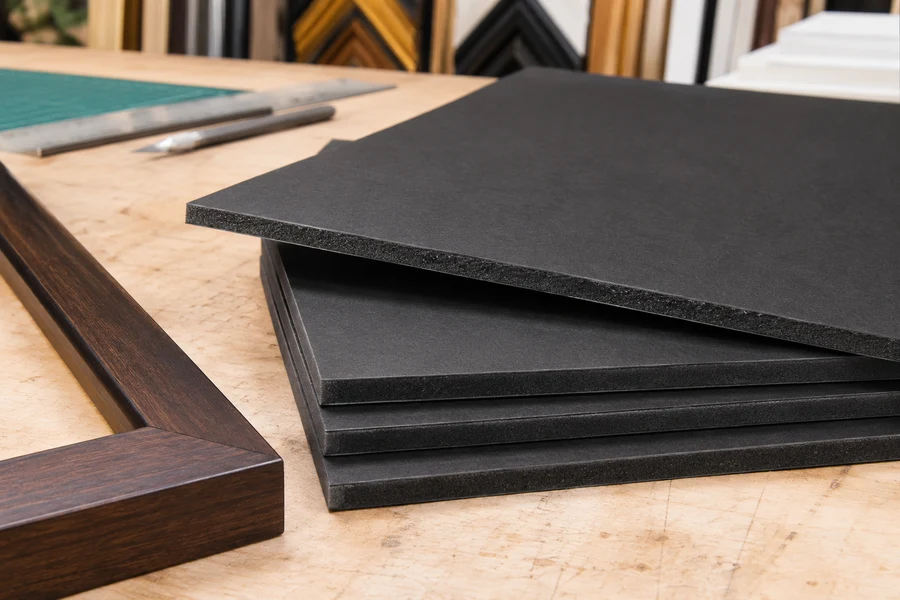
Black acid-free foam board provides a dark backing surface. Decide whether that color will be visible, then confirm thickness, support, and the complete framing package.
Watch: Black Foam Board for Picture Framing
Choose black for the surface you want to see
Black acid-free foam core serves the same general role as the white acid-free backing, with a dark appearance instead.
A black reverse or visible edge can be useful when that surface is exposed in the finished presentation. There is no requirement to use black simply because a frame is dark; decide whether the board's color will actually be seen.
Black backing: decisions and next steps
| Question | Useful check |
|---|---|
| The back is never seen. | Prioritize verified material suitability, stiffness, and fit; color may have little visible effect. |
| A dark border is wanted at the picture edge. | Decide whether a lower mat reveal or another presentation is actually required. |
| The old backing was thinner. | Recalculate package depth and the final retaining position. |
| The sheet is an unidentified offcut. | Verify its source before assigning archival properties. |
| The board is being used as a visible background. | Specify artwork attachment and visible layout separately from the backing color. |
Keep color, material, and thickness separate
The product considered here is black acid-free foam core, and the linked backing is 3/16 inch thick. Do not infer an archival property from the word black on an unrelated board. Check the exact product specification, the outside dimensions, and the complete package depth.
- Identify which face or edge remains visible.
- Confirm that the selected board has the required artwork-contact specification.
- Check whether its thickness fits behind the artwork with the other layers.
- Seat it flat and retain it without crushing the foam.
Choose a mounting method separately
The board supports the package; the artwork still needs an attachment suited to the work. For paper, see artwork hinging. Do not assume that a backing choice calls for permanent adhesive mounting.
View black acid-free foam core or compare the full set of backing materials.
Decide whether the dark face will actually be visible
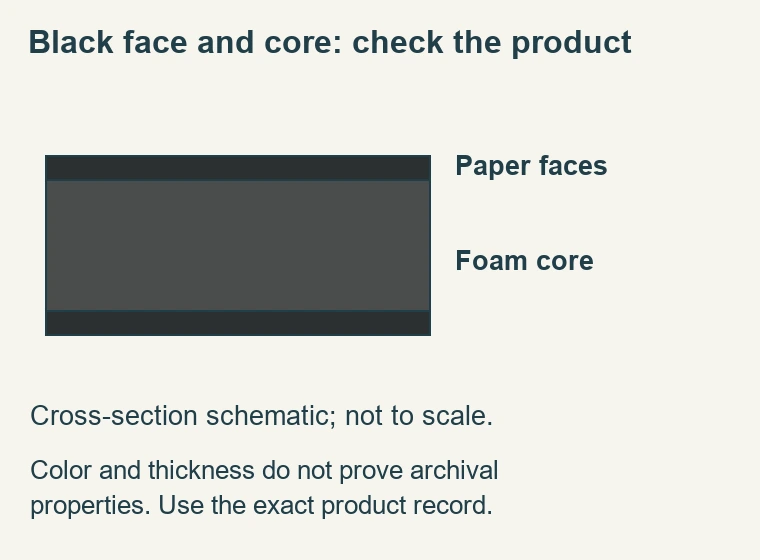
- Black acid-free foam core has a dark face and edge. Its color is the visible distinction, but that does not mean every framing project needs a dark backing. Begin by identifying what can be seen in the completed presentation. In a conventional opaque package, the backing may be entirely hidden from the front. In another arrangement, a reverse face or edge may be exposed and the color may become part of the design.
- Black boards do not all have the same construction, archival property, thickness, or stiffness. Use the currently linked item's verified specification. Use that information for the order rather than treating black as a technical material category that guarantees every other property.
- Compare the dark surface with the actual presentation. A black reverse may suit an exposed back, but it is not required simply because the outer frame is black. If the sheet will not be visible, prioritize the artwork-contact requirements, support, and fit. Color can remain a preference without becoming a reason to compromise another requirement that matters to the work.
Record a visible dark background as a layout
- If the black board is deliberately exposed, record the visible margins and the artwork's position on it. A photograph documents the appearance, but measurements make it repeatable. Keep the attachment method and material specification with that layout. A future replacement should reproduce more than the dark color; it should preserve the intended contact materials and physical support too.
- Before ordering a second matching piece, compare its paper size and edge details with the first. Different artwork can require a different crop or attachment even when the same visible background is wanted. Do not force the second work into the old measurements simply to repeat the outside frame. Preserve the visual relationship deliberately while checking the new object's own support and material needs. That produces a coordinated display without treating color as a substitute for a complete specification.
Keep color, composition, and thickness on separate lines
- Record the selected product as black acid-free foam core, including its actual thickness and outside dimensions. That is more useful than an order note asking for black board. Other dark sheets can be matboard, ordinary foam board, rigid mounting board, or unrelated materials. They may look similar at a distance while behaving differently behind the artwork. Identify the construction before considering an alternative.
- The linked board is 3/16 inch thick. Include that thickness in the package calculation rather than assuming the dark sheet occupies the same space as an existing thin backing. A replacement can look visually appropriate and still change where the completed back sits. That back position determines which retaining arrangement can work, so the thickness decision should be made before installation begins.
- Verify the artwork-contact property from the current product information. Do not infer that property from a dark face, a dark core, or a manufacturer's reputation for another product. If an offcut has lost its identity, it should not be assigned an archival claim because the new project needs one. Keep packaging or an external material record with spare sheets so they can be identified reliably later.
Plan the visible surface without inventing an attachment method
- If a black area is intended to appear around or behind artwork, define its visible dimensions and position. A backing that serves as a visible background is doing an additional design job. The artwork still needs suitable support and attachment. Do not assume that because the background looks attractive the work should be glued directly to it, especially when future removal is part of the brief.
- For a conventional window-matted print, the lower mat and backing are separate components. A narrow black mat reveal comes from the mat opening arrangement, not automatically from the backing's color. Choose the layer construction deliberately. Enlarging the mat window to expose the backing changes the presentation and mounting problem; it is not a simple substitute for ordering the intended lower mat.
- If an edge is visible, inspect its appearance as well as the broad face. A cut edge may read differently under light or beside a pale frame. Use an actual sample and the intended viewing angle. Keep the material's support role in mind while judging color. A decorative use should not rely on a thin or damaged edge to perform a structural job it has not been specified to do.
Check the frame and the rest of the package
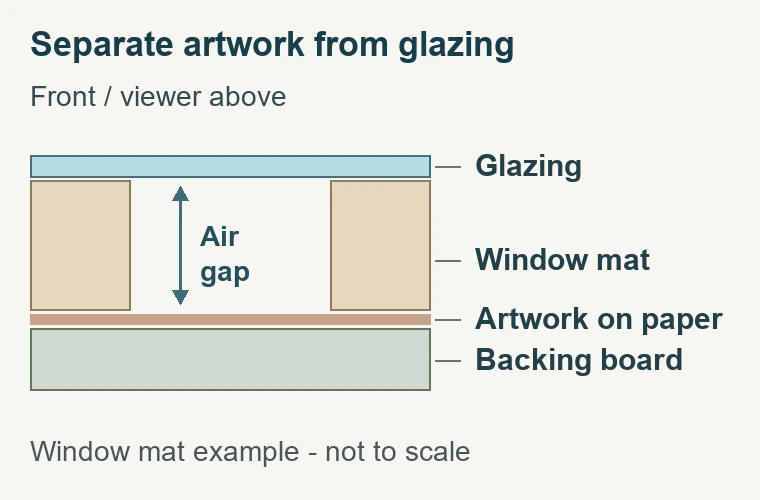
- List glazing, mat layers, spacers, artwork support, and backing before comparing the full arrangement with the usable rabbet. The moulding's overall external height is not a substitute for that internal measurement. A dark frame can be shallow, and a black backing does not become thinner simply because its edge is visually unobtrusive. Use actual dimensions rather than the appearance of the profile.
- Assess support at the required outside size. A small sample does not establish a maximum span or a frame capacity. The actual sheet dimensions, attachment, surrounding support, and artwork package matter. If additional rigidity is required, compare a suitable construction and check the resulting depth. Do not assume tighter retaining hardware can turn a flexible or damaged sheet into the required support.
- Glazing and display requirements remain independent. An acid-free black backing does not establish UV protection at the front, reflection control, or a suitable wall location. Verify those components and conditions for the artwork. A complete package can use coordinated colors while still making distinct decisions about preservation, physical support, and viewing.
Fit the sheet without scuffing or crushing it
- Confirm the material identity, thickness, dimensions, and intended visible side.
- Inspect the face and edges on a clean protected work surface.
- Complete the artwork attachment and support arrangement.
- Seat the backing evenly without forcing an edge against the frame.
- Apply the appropriate retainers without compressing the foam.
- Inspect the front and any exposed reverse or edge before finishing.
Handle the visible face as part of the presentation. Keep abrasive debris, loose screws, and dirty tools away from it. Do not assume a dark surface will conceal every mark. If a sheet is supplied with damage, document the location before attempting a touch-up or cleaning treatment that may change the face. Follow the actual board's guidance where a remedy is required.
If the backing bows or the retainers dent it, stop and inspect the fit. An over-deep stack, catching edge, or unsuitable retaining arrangement can distort the support. Increasing pressure may make the problem less obvious at the back while changing the artwork's front alignment. Resolve the cause before adding a paper cover, which conceals the back but does not correct its construction.
Match the choice to the actual problem
- Keep the selected board and final layout with the order record. If the work later changes, reassess whether the visible dark area and attachment remain appropriate. A replacement image may have different paper margins or contact requirements. Preserve the useful parts of the earlier specification without assuming that every new artwork should inherit the identical construction.
- Review the supplied scope before ordering. A black backing sheet does not automatically include a hinge, adhesive, window mat, glazing, retainers, or hanging kit. Confirm those separately where needed. Keep the exact material, size, thickness, support, and fitting purpose clear in the final package record.
Made in the USA
Handcrafted by American framing experts
Family Owned
Serving customers for over 40 years
Premium Shipping
Professionally packaged for safe delivery
Ready to Hang
Hardware included with all frames
Framing Specialists
Over 40 years of custom framing experience