Ok

Ok

What is the question
Cancel
PICTURE FRAMES
 CUSTOM PICTURE FRAMES
Design Your Framing Package Online!
Add Mats, Glass & Acrylic, Mounting Board And More.



Search
☰

My Account
Log In
Favorites
Saved Designs
Shopping Cart

Understand what changes a custom mat quote, read the pricing tables correctly, and compare designs using the same size, materials, and quantity.
Watch: how custom mat pricing works
The video explains outside-size pricing, material categories, quantity discounts, and cutting efficiency. Its recorded dollar amounts are historical examples; use the current prices below and your completed design for a quote.
What does a custom mat cost?
The price depends on the full outside size, board type, number of layers, and quantity. The opening size alone is not enough to quote a mat. Start with these archival-board examples, then price the exact design you need.
| Outside size | 1 mat | 2-4 mats, each | 5-10 mats, each |
|---|---|---|---|
| 8 x 10 inches | $7.05 | $6.35 | $5.71 |
| 16 x 20 inches | $12.70 | $11.43 | $10.29 |
These examples cover mat board only, without selected extras, shipping, tax, or other framing components. Your material, design, and qualifying quantity determine your price.
1. Use the outside dimensions, not the window opening
Record the full outside width and height of the mat, not just the image or window opening. When using the pricing tables, choose a size band that accommodates both outside dimensions.
Example: a 7 3/4 x 9 3/4 inch opening with 2-inch mat borders on all sides has outside dimensions of 11 3/4 x 13 3/4 inches. Price the full board size, not the smaller opening.
Both outside dimensions must fit the listed band. A mat with one dimension over a band's limit needs a different band even if the other dimension is smaller. Enter the actual dimensions in the pricing table to see the applicable comparison.
Use the illustrated mat-measuring guide if you need to distinguish paper size, image size, window opening, and outside mat size.
Why a small change in size can change the price
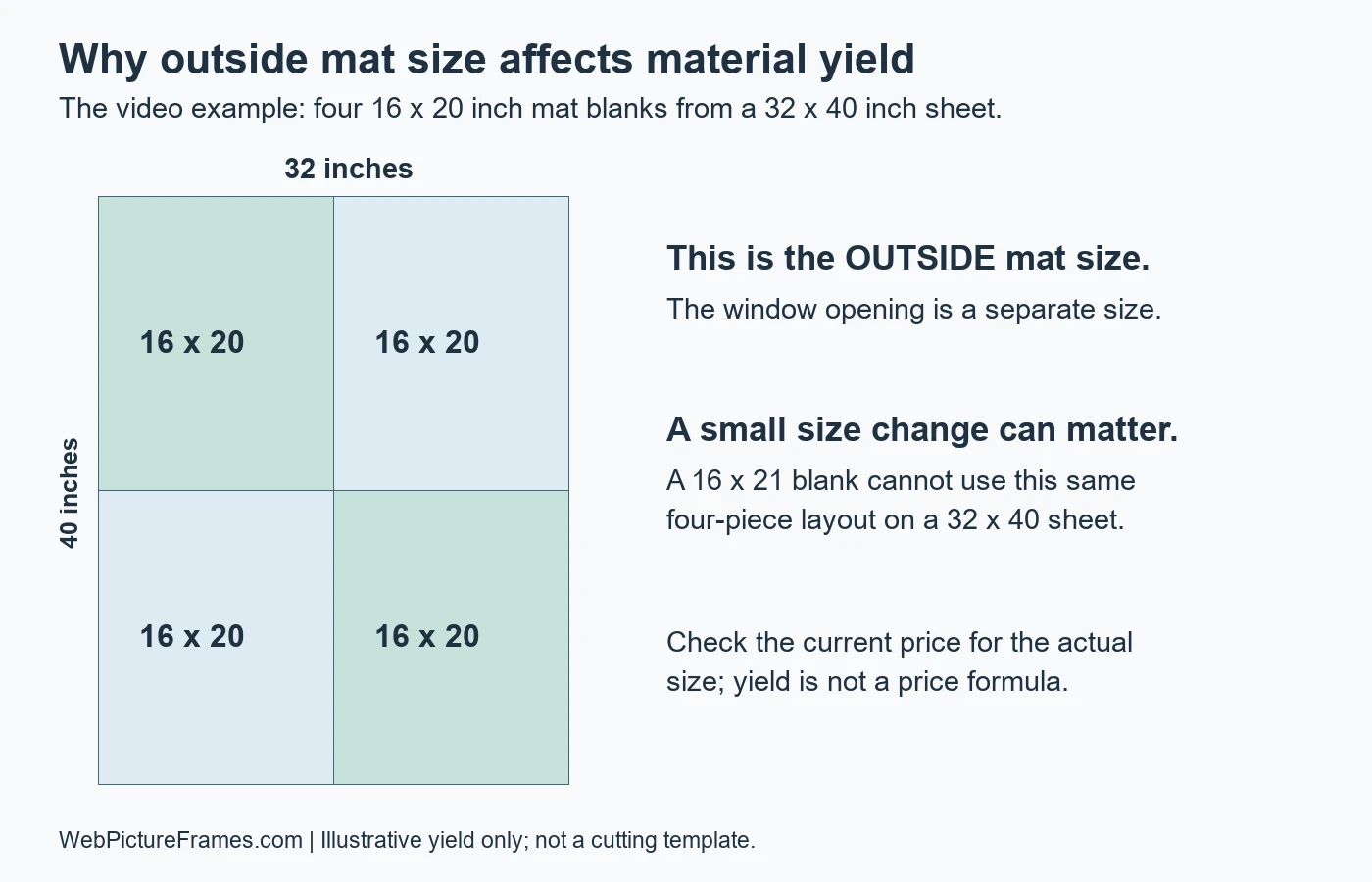
Cutting efficiency helps explain why prices do not always increase smoothly with area. In the video, a 32 x 40 inch sheet yields four 16 x 20 inch blanks. Increasing a blank to 16 x 21 means that same four-piece layout no longer fits.
If you are planning a new series of artworks, compare suitable finished mat sizes before settling on the format. If the artwork already exists, protect its intended presentation: do not crop a signature or choose cramped borders just to stay in a lower band.
The video also discusses larger sheets for oversized mats. Check the selected board's available size and current quote rather than assuming every color and material is available in an oversized sheet.
2. Account for materials, thickness, and each layer
Choose the board material and thickness required by the artwork. For double or triple mats, add the price of each selected layer rather than assuming all layers have the same price. Include any selected extras in the completed design.
| Choice | What to compare |
|---|---|
| Board material | Compare prices within the board type appropriate for the artwork. Economy paper, archival, museum, fabric, metallic, and black-core choices have different pricing categories. |
| 4-ply or 8-ply | Check the quoted board type. A thicker board changes the bevel depth and the package thickness; do not treat it as the same material price. |
| Single, double, or triple mat | Count each layer and its actual unit price. A narrow visible reveal still comes from another mat board behind the top layer. |
| Design extras | Review selected V-grooves, fillets, opening shapes, collage layouts, hinging tape, or spacing options in the completed design. |
When does doubling the price work? Only when both layers have the same unit price for the applicable size and quantity. For different materials, use top layer price + lower layer price. Add a third layer separately, then include selected extras.
A narrow accent does not make the lower layer free, and an 8-ply single mat is not the same design as two separate 4-ply mats. For preservation and appearance decisions, use how to choose a picture mat; this page helps you compare the resulting costs.
3. Compare the quantity you actually need
Enter the intended quantity in the pricing table or designer. Compare per-mat or per-package prices as well as the total, keeping materials, dimensions, and options consistent.
The current public pricing tables show quantity columns for 1, 2-4, 5-10, 11-39, 40-199, 200-999, and 1000+ mats. Use the applicable column and verify the completed design rather than assuming that any mixed order will qualify in the same way.
Keep number of layers separate from number of finished packages. Two double-mat packages contain four boards, but your estimate should use the designer's quantity price for the selected design.
For repeated work, compare bulk mat bundles when their offered materials, sizes, and openings fit the project. Buying full sheets is another option for people equipped to cut mats; include cutting time, tools, and waste in that comparison.
4. Compare the complete order, not just one board
Review the finished mat design and cart, including selected extras, any backing or other components, shipping, and applicable tax. Distinguish the cost of one mat board from a multilayer mat package or a complete frame package.
For each finished design: add the selected mat layers and extras. Multiply the per-design price by the number of designs, then review other selected components and order charges in the cart. If a screen already shows the extended total, do not multiply it again.
Keep outside size, opening, material, thickness, layers, extras, quantity, and delivery requirements the same when comparing quotes. A lower price for a different board or a smaller outside mat is a different specification.
A mat price is not a complete frame-package price. If you also need glazing, backing, and a frame, use what to order with a picture frame to plan the remaining items.
Keep a like-for-like estimating worksheet
Outside mat size: __________ Window opening: __________
Number of finished designs: __________
Top mat material / thickness / unit price: __________
Second mat material / thickness / unit price, if used: __________
Third mat material / thickness / unit price, if used: __________
Selected extras per design: __________
Mat package price per design: __________ Extended mat total: __________
Other components / shipping / applicable tax: __________
Final order total: __________ Quote checked on: __________
Print this page or copy the fields into your project notes. Use the same specifications when comparing another design or supplier.
Common mat-pricing questions
Is a mat priced by its opening or its outside dimensions?
The pricing tables use the outside dimensions of the mat board. An 8 x 10 inch image with a wider mat may need a larger pricing band. Record the window opening and the outside mat size separately.
Does a double mat always cost twice as much?
Doubling one board's price is an estimate only when both layers have the same unit price. A double mat with different materials or thicknesses requires adding the price of each layer. Selected extras and order charges are separate.
Why can a slightly larger mat cost more?
Mat pricing uses size bands, and outside dimensions affect how efficiently blanks can be cut from a sheet. The video illustrates four 16 x 20 inch blanks from a 32 x 40 inch sheet; a 16 x 21 inch blank cannot use that same four-piece layout. Check the current price for the actual dimensions.
Can I use the dollar amounts shown in the video?
Use the video to understand the pricing method. Its recorded dollar examples are not a current quote. Check the current pricing table and the completed design for today's material, size, quantity, and option prices.
How can I reduce mat costs without making the wrong material choice?
First choose a board appropriate for the artwork. Then compare a single mat with a layered design, review suitable outside sizes and quantity pricing, and consider bulk bundles when their sizes and materials fit the project. Do not sacrifice preservation requirements or crop important artwork just to reach a lower price band.
Price your mat or compare materials
Build and price your mat Compare custom mat options
Need a quote for an unusual size, layout, or repeated project? Ask our framing specialists.
This guide explains the WebPictureFrames.com pricing video using the current pricing tables and mat-design options. Our family-owned business has more than 40 years of practical framing experience. Learn about our framing shop.
Made in the USA
Handcrafted by American framing experts
Family Owned
Serving customers for over 40 years
Premium Shipping
Professionally packaged for safe delivery
Ready to Hang
Hardware included with all frames
Framing Specialists
Over 40 years of custom framing experience