Ok

Ok

What is the question
Cancel
PICTURE FRAMES
 CUSTOM PICTURE FRAMES
Design Your Framing Package Online!
Add Mats, Glass & Acrylic, Mounting Board And More.



Search
☰

My Account
Log In
Favorites
Saved Designs
Shopping Cart
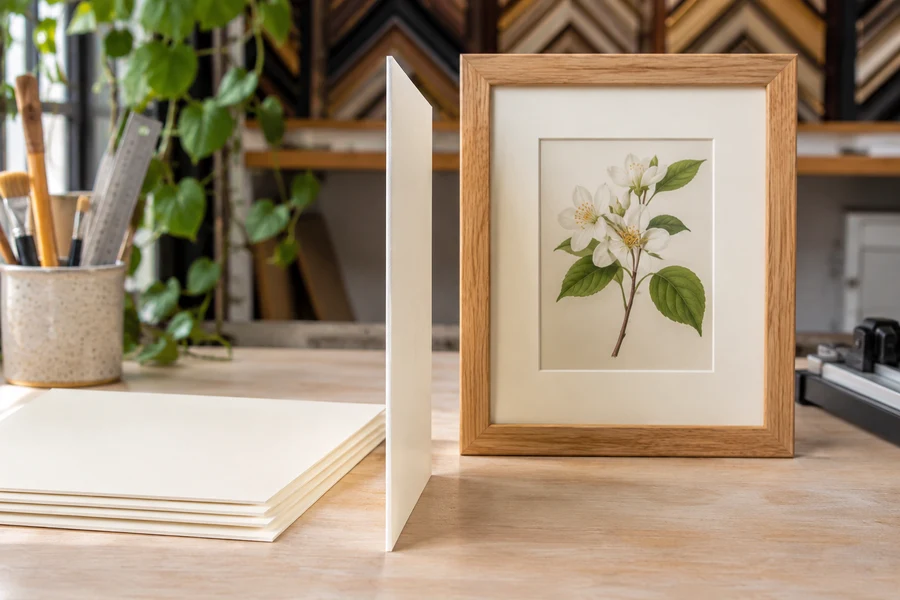
Matboard is a relatively thin backing option with different stiffness from foam board. Check the contact-material specification and whether additional rigid support is required.
Watch: Mat Board as Picture Frame Backing
A thin sheet with different stiffness limits
Four-ply matboard is a relatively thin backing sheet. It takes less depth than the foam boards discussed, but it is also less rigid. Thinness helps with space; it does not guarantee enough support for every frame size.
Backing matboard is a support sheet, rather than a window mat simply because both are made from mat board. Choose the dimensions and construction for the job the sheet needs to perform.
Thin contact sheet or a more rigid support?
| Arrangement | Role | Fit consideration |
|---|---|---|
| Matboard backing alone | A relatively thin backing sheet. | Assess stiffness over the actual dimensions. |
| Verified acid-free matboard | The selected artwork-contact material. | Appearance alone does not identify the specification. |
| Matboard plus rigid support | Separate sheets provide contact and additional stiffness. | Both layers add to total package depth. |
| Foam-board alternative | A different backing construction. | Compare actual thickness, material properties, and usable rabbet. |
Specify decorative or acid-free material
Distinguish decorative paper board from verified acid-free matboard. Both examples are white, so appearance alone does not identify the protective specification. Choose a verified acid-free option when the artwork requires that contact-material specification.
If a thin artwork-contact sheet needs extra stiffness behind it, consider a separate rigid support layer. That changes the total package thickness, so check the available rabbet before adding it.
Check the full support arrangement
- Confirm the material specification needed for the artwork.
- Check whether the sheet remains suitably flat over the intended dimensions.
- Include any separate support board in the package depth.
- Retain the contents without bending or buckling the matboard.
The acid-free matboard and foam-core backing set supplies separate support and rigid layers. Compare other backing constructions before choosing.
Use thin matboard for the job it can actually perform
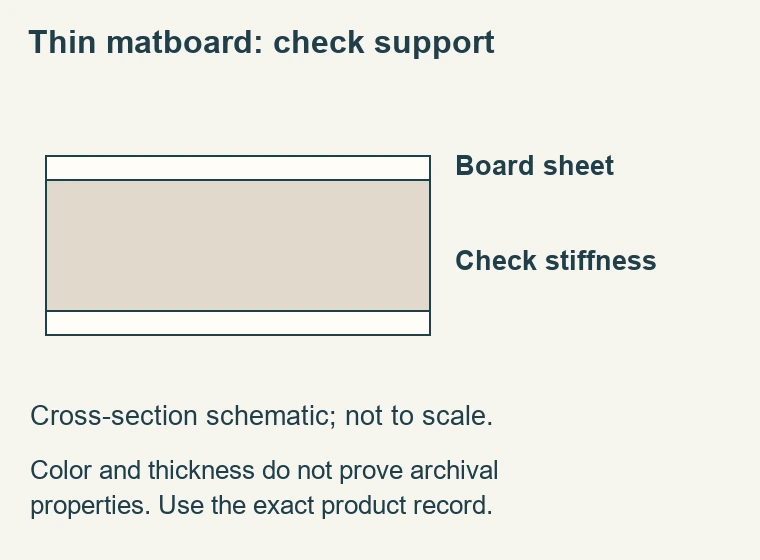
- Matboard backing occupies relatively little depth, but its stiffness differs from thicker foam board. Thinness can help a shallow package. It does not by itself establish enough support for every frame size or artwork. Evaluate the sheet in the intended construction rather than choosing it only because it fits into a narrow recess.
- There is no single maximum unsupported size for every four-ply board. The actual dimensions, board specification, frame support, and mounting arrangement matter. A small sample that feels adequate in the hand does not demonstrate how a full backing panel will behave across a larger opening.
- Matboard is also used for window mats, but the backing's function is different. A window mat has a cut opening and a visible border. A backing sheet supports the package from behind. The same general material family can serve both functions without making their dimensions or material requirements interchangeable. Specify which component is being ordered instead of relying on the word mat alone.
Review the reason an older package used a thin sheet
An existing frame may contain thin matboard because its rabbet was shallow, because another support layer sat behind it, or because a particular contact surface was required. Identify that arrangement before replacing only the visible sheet. Do not assume the old board performed every support function by itself. Record the layers in order and measure the complete stack. If a new backing changes thickness or stiffness, recheck the retaining position and front alignment. The useful replacement preserves the required contact material while supplying the support and fit needed now, rather than repeating an incomplete understanding of the older construction.
Verify the sheet that will touch the artwork
- Distinguish decorative board from an identified acid-free option. Both may look white, so casual appearance does not identify their suitability for a particular work. Confirm the current specification of the board selected for contact with the artwork. A new, clean, or thick-looking sheet should not be assigned an archival claim without that verification.
- Look at the entire contact arrangement. A suitable upper window mat does not establish the properties of an unrelated backing. If another rigid layer sits behind the matboard, record that construction too. Keep the artwork attachment and any intermediate materials identified. The relevant question is which materials actually contact or support the work, not only which board is most visible when the frame is open.
- Choose the attachment method separately. A thin acid-free backing does not mean that every adhesive is appropriate, and a board that is easy to fit does not automatically make a reversible mount. Consider the artwork's condition and any need for future removal. If the work is valuable, fragile, or unfamiliar, seek an appropriate assessment before attaching it permanently to any support.
Consider a separate rigid layer where needed
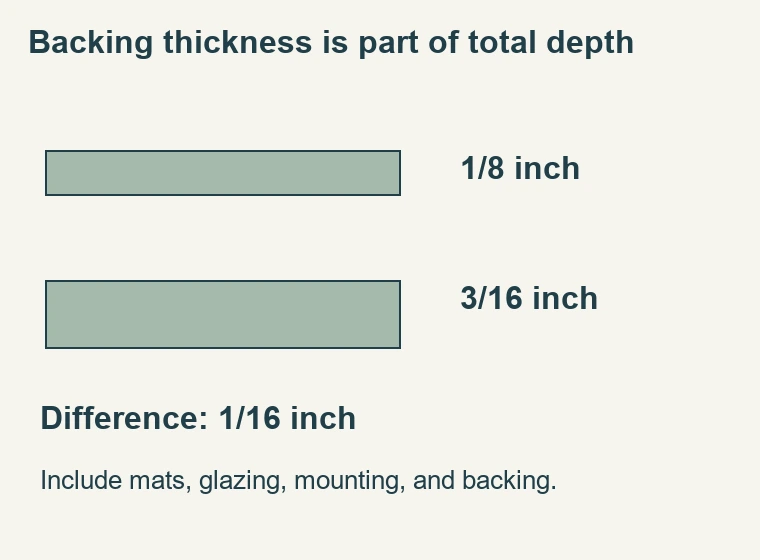
- A thin contact sheet and a separate rigid support can perform different roles within one package. The matboard can provide the selected artwork-contact surface while another board supplies additional stiffness. That possibility is mentioned in the original guide and reflected in the linked backing set. It is not a reason to add layers indiscriminately: confirm the required properties and physical fit for the actual project.
- Adding a second support changes the total depth. Include both sheets with glazing, mats, artwork, spacers, and any other required components. Compare the resulting arrangement with the usable rabbet. A solution chosen to gain rigidity may remove the depth advantage that led to the thin sheet in the first place. Evaluate the complete package before ordering a frame around only one component.
- Do not use a thin contact layer as a reason to leave the structure behind it unspecified. Confirm the separate board's dimensions, support, and compatibility with the rest of the package. A stack can contain suitable individual materials while still fit poorly if their outside sizes differ unexpectedly or an edge catches the frame. Check the assembled geometry rather than only a list of material names.
Measure the outside package and inspect existing frames
- The backing's width and height should match the required receiving arrangement. They are not automatically the visible artwork window dimensions. A broad mat can make the complete package much larger than the image. Use the current designer's measurement convention or measure the actual frame opening, and keep any supplier allowance separate from the artwork crop.
- If replacing an old sheet, inspect it before copying its size. A bowed, torn, or badly fitted backing may reflect an earlier fitting problem rather than the correct target. Measure the receiving opening and check whether the mat or glazing has changed. Replacing like for like is useful only when the original arrangement still meets the current artwork and frame requirements.
- Record thickness as well as the number of plies stated for the supplied board. Do not convert a ply description into an exact thickness for an unrelated product. Use the actual specification and measurements relevant to the chosen item. The package's final back position matters to the retainers, so an assumed thickness can create a practical problem even when width and height are correct.
Fit a thin sheet without buckling it
- Verify the material and required dimensions before bringing it into contact with the work.
- Inspect for dirt, creases, damaged edges, and unintended curvature.
- Complete the selected mounting arrangement and any separate support layer.
- Seat the matboard evenly in the frame without forcing it against the sides.
- Use retainers suited to the completed stack and avoid pressure that bends the sheet.
- Inspect the front and back before adding a finishing cover.
A thin backing can show a fit problem quickly. If it buckles, identify whether it is oversized, caught against a rail, or being pushed by a component beneath it. Do not assume that more points or stronger pressure are the solution. The correct response may be a dimension correction, a better seated package, or a different support construction.
Check the artwork position from the front after retention. A backing that appears neatly held can still accompany a shifted image or mat. Support the frame while turning it for inspection and look around the full window. If a component moved, reopen and resolve its intended attachment instead of relying on a tighter stack to prevent it from moving again.
Questions that clarify the backing choice
Is the shallow frame the reason for choosing matboard?
If so, verify that the complete thin arrangement still provides the support and contact properties required. Limited depth is a constraint, not evidence that any thin material is suitable. A different frame may be the coherent solution when required components cannot fit. Do not remove backing, glazing separation, or mounting support solely to preserve the appearance of a shallow moulding.
Is the board expected to hold the artwork by itself?
Specify the artwork attachment and the backing support independently. A flat sheet does not automatically locate the picture, and tight retainers are not a universal mounting method. Keep any requirement for future removal in the plan. If another rigid layer is needed, include it explicitly rather than leaving that decision until the package is already too deep.
Can an unidentified mat offcut be used?
Only after its relevant properties and dimensions are known for the intended use. A pale surface or familiar texture is not a verified material specification. Keep offcuts with their source information where they may be reused. If the project requires archival contact and the material cannot be identified, select a verified board instead of assigning the needed property by appearance.
Finish with a clear record of the contact sheet, any separate rigid support, outside size, actual thickness, mounting method, and retaining arrangement. Check which components the order includes. Thin matboard can serve a useful role in a planned package, but it should be chosen for a defined purpose with its stiffness limits understood, rather than treated as a universal substitute for every thicker backing.
Made in the USA
Handcrafted by American framing experts
Family Owned
Serving customers for over 40 years
Premium Shipping
Professionally packaged for safe delivery
Ready to Hang
Hardware included with all frames
Framing Specialists
Over 40 years of custom framing experience