Ok

Ok

What is the question
Cancel
PICTURE FRAMES
 CUSTOM PICTURE FRAMES
Design Your Framing Package Online!
Add Mats, Glass & Acrylic, Mounting Board And More.



Search
☰

My Account
Log In
Favorites
Saved Designs
Shopping Cart
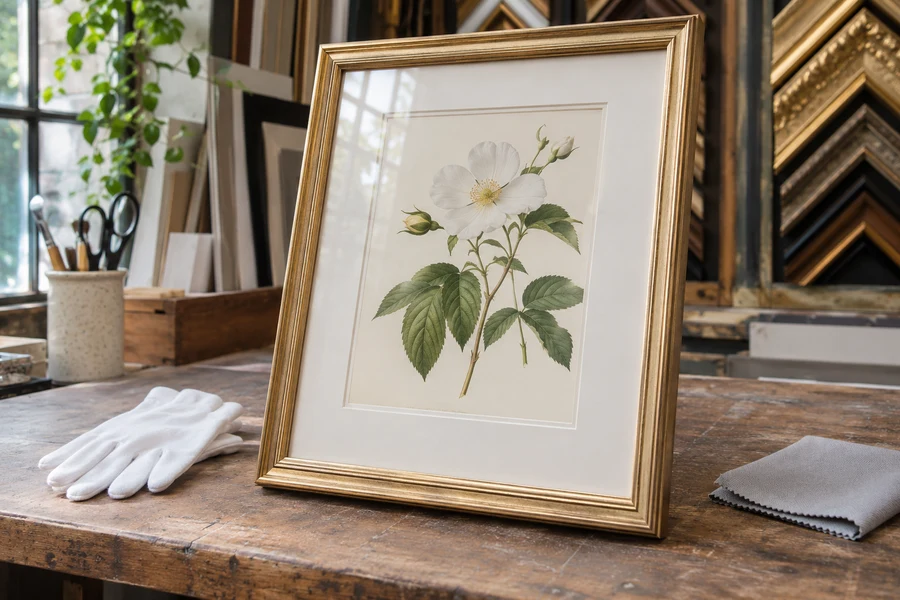
Optium Museum Acrylic combines anti-reflective viewing, UV filtering, anti-static properties, and abrasion resistance. Select it by the features your artwork and handling plan require.
Watch: Optium Museum Acrylic for Picture Frames
What differs from conventional non-glare acrylic?
Optium Museum Acrylic combines anti-reflective viewing with anti-static properties and abrasion resistance. Compare its coated surface with conservation non-glare acrylic, which diffuses reflections. Test both over the actual artwork and intended gap.
Use the manufacturer's precise terms when assessing those features. Tru Vue specifies anti-static and abrasion-resistant properties, anti-reflective viewing, and up to 99 percent UV blocking. Abrasion resistance does not mean the surface cannot be scratched.
Optium selection checklist
| Question | What to record |
|---|---|
| Which viewing method is wanted? | Coated anti-reflective appearance compared at the intended gap and viewing angle. |
| Which protective properties are required? | The exact current UV and anti-static specifications relevant to the project. |
| What physical sheet is needed? | Receiving dimensions, thickness, support, and package depth. |
| How will it be maintained? | Product-specific handling, cleaning, and storage instructions. |
| What does the quote include? | The pane and all separately required mounting, backing, retaining, and hanging components. |
Decide whether the combination is useful for your project
- Compare the appearance over detailed artwork and through the intended mat or spacer depth.
- Assess whether anti-static performance is required for the artwork and fitting method.
- Confirm the UV-filtering requirement and the actual sheet thickness and size.
- Compare the quoted price with alternatives supplying the features your project needs.
Choose by the feature combination: anti-reflective appearance, UV filtering, anti-static performance, and abrasion resistance. Those features do not remove the need for appropriate mounting and display conditions.
Use care instructions for the coated surface
Do not automatically apply the cleaner or polish used on uncoated acrylic. Follow Tru Vue's product-specific handling and cleaning guidance; polishing compounds intended for ordinary acrylic are not a substitute for those instructions.
View Optium Museum Acrylic and compare all acrylic glazing options before completing the frame package.
Choose the combination of properties the project needs
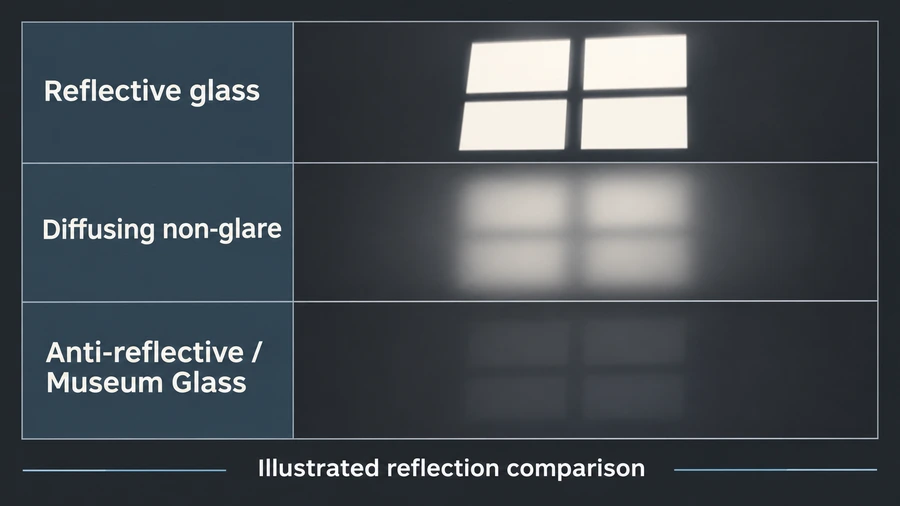
- Optium Museum Acrylic combines several features rather than only changing a reflection. Its anti-reflective appearance, UV protection, anti-static behavior, and abrasion resistance should be evaluated as separate properties that happen to be supplied together. Determine which of those properties matters for the artwork, display, and handling. That gives a clearer basis for the choice than repeating a general claim that one glazing is always preferable.
- A coated pane does not make every mounting or display arrangement appropriate. The frame still needs suitable depth, artwork support, backing, separation, retainers, and hanging hardware. Nor does the product name identify the construction of every other acrylic sheet described informally as museum glazing. Record the exact supplied product.
- Start with a short project brief: the artwork and medium where known, required protection, normal viewing distance, planned gap, expected transport, and any special handling concern. Then compare alternative panes against that brief. A project that needs a specific anti-static property should not lose it merely because another sample has a similar reflected appearance. A project that does not need every property can still compare the cost and benefit coherently.
Pass the care information to the next owner or fitter
A coated pane may eventually be cleaned or serviced by someone who did not select it. Keep its identity and care instructions with the artwork record, along with the mounting and separation notes. That avoids relying on its clear appearance to communicate the surface treatment. If the frame is sold, gifted, or sent to another shop, supply those details with it. The practical benefit of a specified glazing product depends partly on continuing to handle it as that product, rather than treating every transparent sheet as ordinary glass or conventional uncoated acrylic.
Compare the anti-reflective view through the finished gap
- Use detailed artwork and a realistic mat or spacer arrangement in the sample test. Look through the pane at the image and look at the room reflected on its surface. Those are separate parts of the viewing experience. Compare this coated approach with a diffusing non-glare surface. Reproduce that comparison at the actual artwork-to-glazing distance rather than assuming both treatments behave the same behind several mat layers.
- Check dark areas, fine text, and subtle surface detail in the work. Move to the normal viewing position and then to useful side angles. Include the intended room lighting. An anti-reflective designation does not mean that no reflection can appear under any combination of angle and light. Decide whether the remaining reflected appearance is acceptable in the actual display rather than requiring an artificial test in which a pane must disappear completely.
- Where possible, compare with the intended outer frame and mat colors. Their surfaces can influence the overall impression even though they do not change the pane's specification. A sample viewed over an unrelated bright picture may conceal a reflection that matters over a dark drawing. Keep the test image and geometry constant so the material comparison is useful rather than a comparison of two different presentations.
Keep anti-static and abrasion-resistant claims precise
- The manufacturer's anti-static specification is relevant when that property is required by the artwork and fitting plan. It should not be rewritten as a promise that no static effect can ever occur in any part of the assembly. For delicate or friable media, assess the whole mounting and separation arrangement with appropriate expertise. A specified glazing property is one input to that decision, not a reason to improvise handling of an unfamiliar artwork surface.
- Abrasion resistance also needs precise language. It does not mean scratch-proof. Keep the pane away from grit, sharp tools, dirty pads, and unnecessary rubbing. A coated surface can be damaged by an inappropriate care method even when its ordinary handling resistance is an advantage. Preserve the supplied instructions so the person cleaning the completed frame knows that this is a particular coated acrylic product.
- Do not try to demonstrate those features by scratching, rubbing aggressively, or creating a static test over the artwork. Such experiments are not required to confirm an identified product and can damage the pane or work. Use the verified product documentation and supplier record. If the supplied material is in doubt, ask the supplier to identify it rather than performing destructive tests on a component intended for the final frame.
Confirm size, thickness, and the complete framing construction
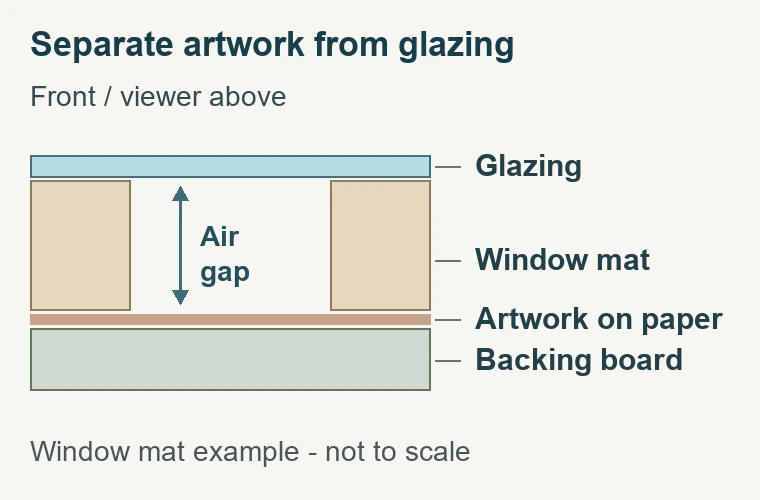
- Order the glazing dimensions that the frame receives, following the designer's convention. The outside moulding dimensions and the artwork's visible window are different references. A mat can make the package larger than the image, and a multi-layer construction adds depth. Record the exact pane size and thickness rather than assuming every sheet in the product range has one standard geometry.
- Measure the full package against the usable rabbet. Include the pane, mats or spacers, artwork support, backing, and any other required components. The final backing position affects the retaining arrangement. An attractive shallow moulding should not be retained by omitting necessary support or forcing a deep package into it. Evaluate the front proportions and the internal fit as separate requirements.
- Verify artwork-contact materials and attachment independently. The glazing's UV specification does not establish that the mat, backing, or adhesive is appropriate. Keep a suitable gap between the artwork and pane as required by the project. A complete order should make clear which components are included and which fitting steps remain. A single premium component does not turn an incomplete package into a finished framing solution.
Use the coated-product care method from the start
- Prepare a clean, supported work area before exposing the viewing surfaces. Follow the supplied instructions for masking removal and handling, and inspect both faces before fitting. Keep blades and loose hardware away from the pane. If a surface mark appears, identify whether it is dirt, remaining film, residue, or physical damage before choosing a remedy.
- Use Tru Vue's instructions for Optium Museum Acrylic rather than automatically applying conventional acrylic cleaner or polish. The manufacturer's product sheet and care information distinguish its cleaning requirements. A polishing compound intended to alter the surface of an uncoated acrylic sheet is not an interchangeable maintenance step for a coated pane.
- After cleaning as directed, fit the components without dragging the artwork or backing across the pane. Inspect the front before installing the final retainers and again afterwards. Check for dust, shifted mats, visible spacer edges, and unexpected contact. Finish the back only after the visible presentation and package fit are correct. This reduces the chance of repeated opening and unnecessary handling of the coated glazing.
Compare the order on a consistent basis
- Keep the exact product identity with the finished artwork record. A future replacement or cleaning decision should not depend on remembering which pane looked clearest in a comparison years earlier. If the artwork or display changes, reassess the requirements rather than transferring the old choice automatically. The feature combination is useful when it meets a defined need; the rest of the frame should continue to support that need.
- For a price comparison, use equivalent sizes and the required feature set. A lower quote for a different pane may reflect missing properties rather than a like-for-like saving. Conversely, there is no need to invent requirements simply to justify the more extensive specification. Choose the product because its documented combination serves the artwork and display, and preserve the practical details needed to fit and care for it correctly.
Made in the USA
Handcrafted by American framing experts
Family Owned
Serving customers for over 40 years
Premium Shipping
Professionally packaged for safe delivery
Ready to Hang
Hardware included with all frames
Framing Specialists
Over 40 years of custom framing experience