Ok

Ok

What is the question
Cancel
PICTURE FRAMES
 CUSTOM PICTURE FRAMES
Design Your Framing Package Online!
Add Mats, Glass & Acrylic, Mounting Board And More.



Search
☰

My Account
Log In
Favorites
Saved Designs
Shopping Cart
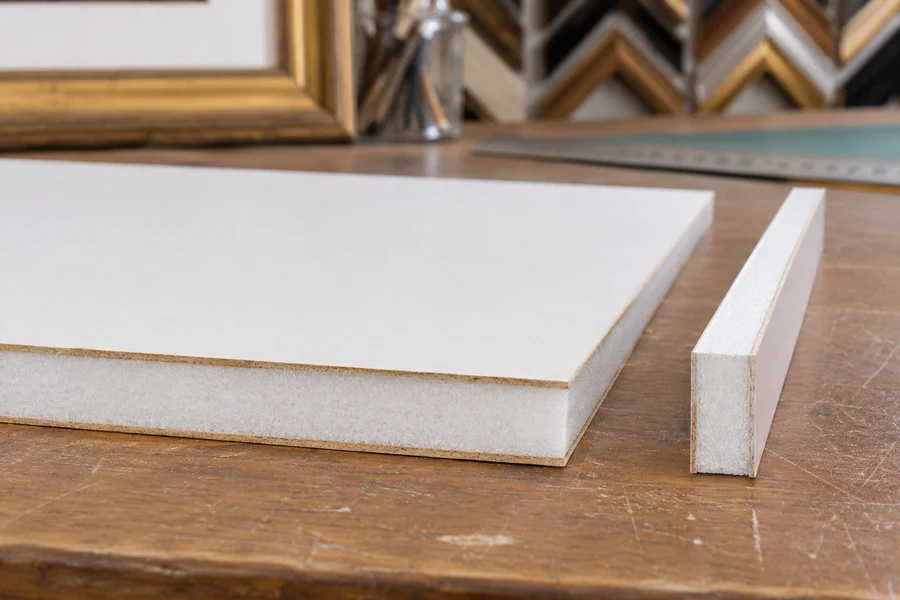
Gatorfoam is a rigid mounting-board option with a polystyrene core and hard wood-fiber veneer facings. Plan dimensions, support, and attachment for the actual project.
Watch: Gatorboard for Picture Framing
What rigidity does and does not establish
Compare the panel's support and handling properties with ordinary foam core. Consider a stiff, lightweight board for mounting, display work, and portable artist supports.
A small sample does not establish a maximum unsupported size or prove that every larger panel will remain perfectly flat. Select thickness, dimensions, support, and attachment for the actual project.
Rigid mounting board and backing board compared
| Construction | Physical distinction | What still needs verification |
|---|---|---|
| Gatorfoam / Gatorboard | Current linked product: foam core with hard wood-fiber veneer facings. | Thickness, dimensions, support, and intended mounting method. |
| Regular foam board | Paper faces over a compressible foam core. | Support and material suitability for the actual package. |
| Acid-free foam board | A verified material option for the specified artwork-contact requirement. | Thickness and fit; the board does not identify an adhesive method. |
| Artist's support | A separate support application to assess. | Preparation and compatibility with the intended medium. |
Use the verified construction for the supplied product
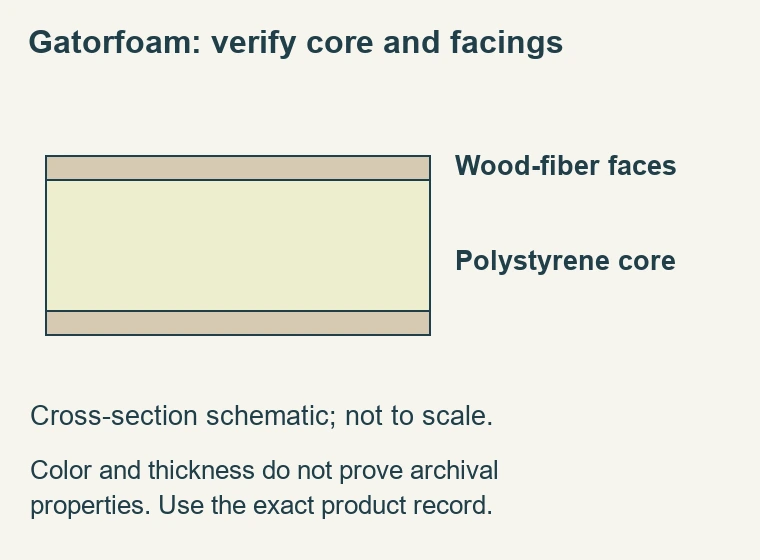
The current product description identifies Gatorfoam, also called Gatorboard, as an extruded polystyrene foam core between hard wood-fiber veneer facings. Those facings distinguish its surface durability from ordinary paper-faced foam board.
Use the current product specification for construction and suitability. Rigidity alone does not establish an archival artwork-contact material.
Plan the mounting or framing use
- Check the required dimensions, thickness, and support.
- Confirm the mounting method and whether it is reversible where that matters.
- For direct artwork contact, verify material compatibility rather than assuming a rigid board is conservation backing.
- If using it as an artist's support, confirm preparation and compatibility with the intended medium.
View Gatorfoam rigid mounting board. For a project that requires acid-free backing, compare acid-free foam core and the broader backing-board guide.
Choose a rigid panel for a specific support need
- Consider a rigid, lightweight board for a specific support requirement. Its useful comparison is with ordinary foam core, not a promise that one panel solves every mounting project. Decide what the board must do: provide a backing, support a mounted display, or form part of an artist's working arrangement. Those uses can require different attachment, surface preparation, and support even when the same general board construction is considered.
- Rigidity does not establish a maximum size, load rating, or guarantee against bowing. A small panel pressed by hand does not certify a much larger unsupported sheet. The actual dimensions, thickness, edge support, mounting method, and expected handling belong in the assessment. Confirm the selected product for the project rather than extending the sample's behavior without limits.
- Keep the current material description with the order. The linked product identifies an extruded polystyrene foam core with hard wood-fiber veneer facings. Keep that verified specification with the panel. Likewise, the word veneer here should not be rewritten as a solid-wood species claim. Use the actual construction rather than an attractive but unsupported description.
Preserve the preparation history with the panel
If the board is used as an artist's support or mounted display, record any coating, adhesive, or intermediate layer applied to it. That history becomes relevant when the object is framed, repaired, or assessed later. A future fitter should not have to assume the panel is still an untreated product. Keep the actual material identity and preparation together, and distinguish an observed surface from a claim about what lies beneath it. This supports a more accurate decision when the finished object changes hands.
Distinguish surface hardness from other material properties
- The hard facings are part of the physical distinction from ordinary paper-faced foam board. That can be relevant where the project needs a more durable surface and a rigid panel. It does not establish the same artwork-contact property as an acid-free backing, nor does it identify an adhesive that is appropriate for every artwork. Treat rigidity, surface behavior, and contact suitability as separate questions.
- Do not infer that a board is archival from its thickness, white face, or resistance to bending. If artwork contact requires a verified material property, check the actual product documentation and complete construction. A separate contact sheet or another board may be required for the intended package, but that arrangement should be specified rather than improvised after the rigid panel has been ordered.
- Compare alternatives using the function needed. Ordinary foam board may supply an appropriate backing for one package, while a harder-faced panel may serve another display purpose. Thin matboard can provide a different contact layer without the same stiffness. There is no useful universal ranking that makes the most rigid board automatically the right one for every paper artwork.
Plan panel dimensions and support together
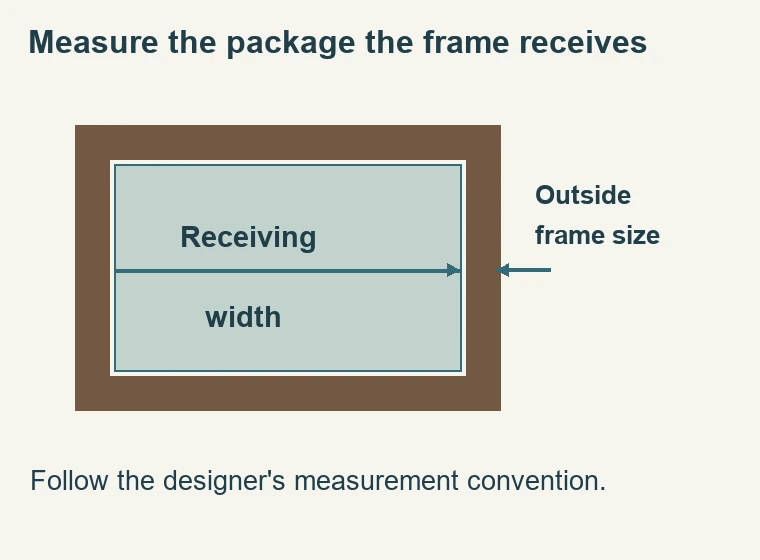
- Establish the actual outside dimensions required by the frame or mounting design. These may be larger than the visible image because of a mat or other border. If the panel will stand or be carried outside a conventional frame, identify how it will be supported and protected. A board selected for a perimeter-supported frame should not automatically be assumed to behave the same way as a large free-standing panel.
- Confirm thickness for the selected size and use. A small sample does not establish a universal thickness chart. Describe the project to the supplier where the support requirement is uncertain. Keep the panel's actual specification in the record so a later replacement is not chosen merely because it has a similar white surface or feels stiff in a small offcut.
- For framing, include the panel with glazing, mats or spacers, artwork, and any other backing or contact layers in the depth calculation. Compare that package with the usable rabbet. A rigid board does not compress into a shallow frame as a valid fitting solution. Determine the final back position and appropriate retainers before selecting a moulding that may not accommodate the construction.
Specify attachment and reversibility before bonding
- A mounting board does not identify a complete mounting method. Decide whether the artwork is to be permanently bonded, attached through a removable arrangement, or supported by another component. Consider the work's medium, condition, value, and future needs. Do not assume that a rigid surface makes every adhesive or pressure process appropriate.
- For valuable or sensitive work, obtain suitable advice before an irreversible attachment. Mounting and display applications still need their own material and attachment assessment. A project intended as a replaceable presentation panel can have different requirements from an irreplaceable print. Define the scope before selecting the board and attachment system together.
- Use the instructions for the actual adhesive, equipment, and board when a mounting process is chosen. This guide does not supply temperatures, pressures, cure times, or cutting settings absent from the verified product and equipment instructions. Those details should not be guessed from a general description of rigidity. A correct panel choice can still be spoiled by an incompatible or poorly controlled process.
Assess an artist's support as its own application
- Portable artist-support use is an application to evaluate, not as proof that an untreated panel is ready for every medium. Confirm any surface preparation, barrier, coating, and attachment required for the intended work. The material at the face is part of the final art support, so compatibility matters beyond whether the board is convenient to carry.
- Plan how the panel will be handled, stored, and framed after use. A portable support can receive edge wear or surface marks that would be undesirable in a finished framing package. Protect the intended image area and avoid relying on the panel's stiffness as evidence that it needs no handling care. Keep the product and preparation record with the work if those details matter to later fitting or assessment.
- If the project changes from a temporary support to a permanent mounted artwork, review the original decisions. A convenient working panel is not automatically the final preservation construction. Describe what was applied to it and how the artwork is attached before selecting additional mats, glazing, or a frame. That information helps the framing team assess the actual object rather than an assumed blank board.
Inspect and fit the panel without forcing the package
- Verify product identity, construction, size, thickness, and condition.
- Inspect the faces and edges for damage or an unintended curve.
- Complete the selected mounting or contact-layer arrangement.
- Check the panel in the frame before adding final retainers.
- Resolve any catching edge, depth mismatch, or support problem.
- Inspect the front after retention and before finishing the back.
If cutting or machining is required, follow suitable product and tool instructions rather than assuming the board should be treated exactly like ordinary paper-faced foam core. Keep the artwork out of the cutting area and inspect the finished edges before fitting. Material identification does not establish a safe machine setup or a universal hand-cutting method.
Retainers should hold a properly seated package. They should not be used to bend a rigid panel into an uneven frame or flatten a construction that does not fit. If the front alignment changes as the back is secured, stop and identify the contact or pressure causing it. A tight-looking back is not a useful substitute for an even, supported assembly.
Keep the project specification complete
- Record the panel construction, dimensions, thickness, mounting materials, and any surface preparation. Include how it is supported and which frame or display arrangement receives it. Those details are more useful than a generic note asking for a stiff foam board. They also prevent an older informal material description from being repeated as the current specification when another person orders a replacement.
- Confirm the supplied scope. A cut panel does not automatically include adhesive, mounting service, glazing, mats, retainers, or hanging hardware. Ask which work remains and which instructions apply to that work. The successful result is a rigid board selected for a defined application, with its contact properties and attachment understood, rather than an unsupported assumption that stiffness alone establishes suitability.
Made in the USA
Handcrafted by American framing experts
Family Owned
Serving customers for over 40 years
Premium Shipping
Professionally packaged for safe delivery
Ready to Hang
Hardware included with all frames
Framing Specialists
Over 40 years of custom framing experience