Ok

Ok

What is the question
Cancel
PICTURE FRAMES
 CUSTOM PICTURE FRAMES
Design Your Framing Package Online!
Add Mats, Glass & Acrylic, Mounting Board And More.




Search
☰

My Account
Log In
Favorites
Saved Designs
Shopping Cart
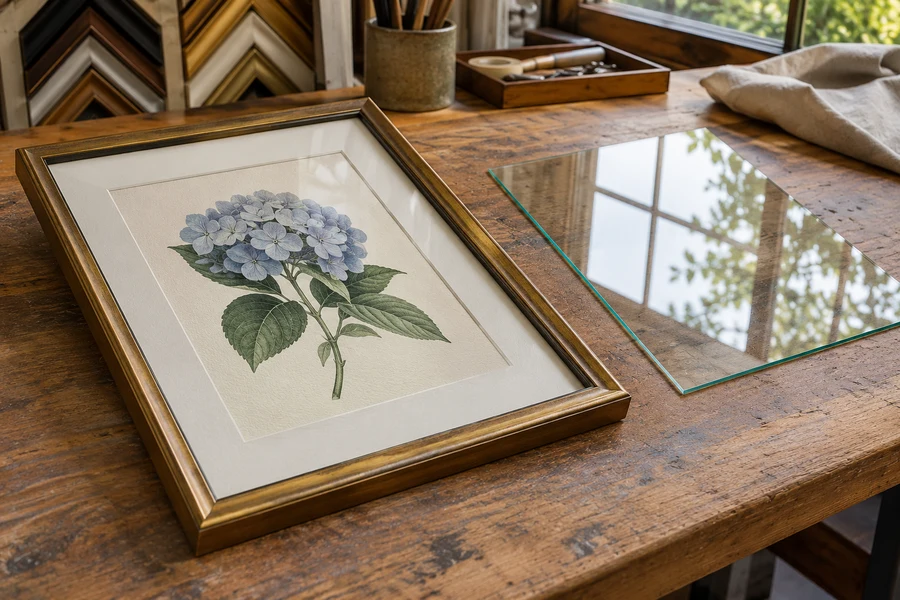
Anti-reflective glass reduces mirror-like reflections through a coated surface. Choose the required UV specification separately and follow the coating-specific care instructions.
Watch: Anti-Reflective Picture Frame Glass Explained
Compare anti-reflective and diffusing surfaces
Compare the anti-reflective sample with regular and non-glare glass. Its coated surface reduces mirror-like reflections without using the same diffusing effect as ordinary non-glare glass.
The benefit is easier viewing of the image under reflected room light. It does not follow that every product called anti-reflective has the same UV filtering, thickness, or care requirements.
Compare glass by reflection method and protection
| Glass category | Reflected appearance | Separate check |
|---|---|---|
| Regular clear | Recognizable room reflections. | Current protection and physical handling requirements. |
| Non-glare | A softened, diffused reflected scene. | Clarity through the intended package depth. |
| Anti-reflective | Reduced reflection through a coated viewing approach. | Exact current UV and care specifications. |
| Museum Glass | A combined anti-reflective and conservation UV-filtering option. | Product identity, orientation, size, and complete frame fit. |
Check the exact product's protective features
- Compare the sample over fine detail at the intended viewing distance.
- Assess reflected windows and lights from more than one position.
- Check UV protection independently of the anti-reflective name.
- Confirm the sheet size, thickness, complete package weight, and frame fit.
Do not apply another anti-reflective product's UV percentage to the specification of the current item. Museum Glass is a current option to compare when both reduced reflections and conservation UV protection are wanted.
Handle and clean the coating correctly
Current Tru Vue care guidance calls for a clean, soft, lint-free cloth and a small amount of ammonia-free cleaner applied to the cloth. Protect the surface from grit and follow the exact product's instructions.
Compare the currently listed anti-reflective glass with Museum Glass. Use the glass guide for the complete decision.
Define the reflection problem before choosing the pane
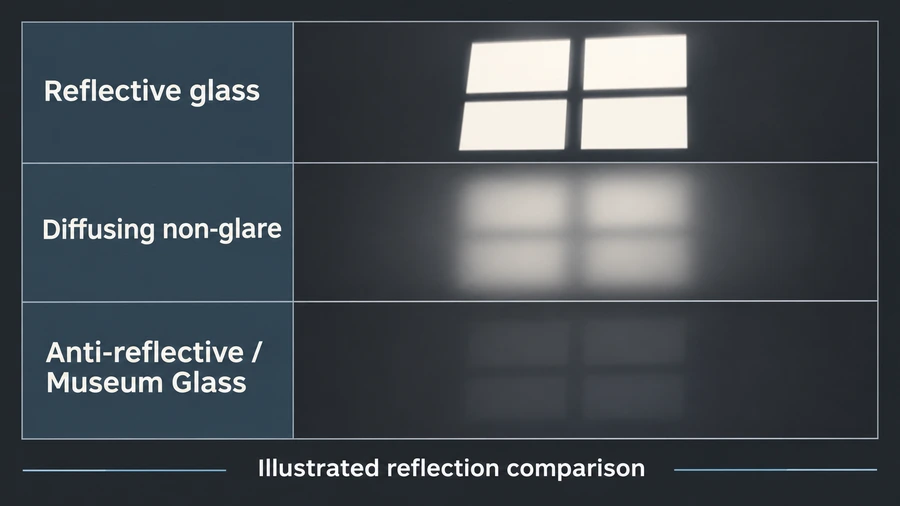
- Anti-reflective glass is a viewing choice intended to reduce the prominence of surface reflections. Compare it with both regular reflective glass and a diffusing non-glare sample. Those are different approaches, so the practical question is which one gives an acceptable view of the actual artwork. Do not choose from the name alone or assume that a pane must become completely invisible under every light.
- Products described as anti-reflective do not necessarily have identical UV filtering, coating construction, thickness, or care requirements. Identify the exact current item. A historical example can explain the category while a new order still needs its own verified specification.
- Write down the obstruction you want to reduce: a bright window across a dark image, a lamp reflected over fine text, or a room that appears strongly in the pane at normal viewing distance. That observation provides a useful test. A general preference for less glare is harder to evaluate than a specific reflected object and viewing position that can be compared with several samples.
Reassess the view when the room changes
A new lamp, a moved desk, or a different picture height can change the reflected scene even when the pane is unchanged. If a previously satisfactory frame becomes difficult to view, reproduce the normal viewing position and identify the new bright source. Check the surface for ordinary dirt as a separate step. Do not assume the coating has failed merely because the room has changed, and do not apply a stronger cleaning treatment to solve a lighting problem. If another pane is considered, repeat the comparison with the artwork's actual gap and required protection properties. Keep the accepted arrangement in the display record. That makes later troubleshooting a focused comparison of conditions rather than a series of unnecessary replacements based only on the general expectation of glare-free viewing.
Compare the coated view with a diffusing finish
- Use the same image and gap for the comparison. A detailed photograph, drawing, or text sample can help reveal whether the viewing treatment preserves the information important to the project. Your artwork supplies the relevant detail for the comparison. Keep the pane clean so a surface mark or remaining preparation residue does not become mistaken for a coating effect.
- Look through each sample and at its reflected room. A diffusing surface softens the reflected scene; a coated anti-reflective surface addresses the reflection differently. A deeper mat or spacer arrangement can make the distinction especially relevant. Include the required separation rather than testing every pane directly against the image and assuming the result will remain unchanged in the frame.
- Assess the normal viewing position and useful side angles. A picture may be seen while walking past, from a chair, or from below a high wall position. Test those positions under the actual lights where practical. If a reflection remains at an unusual angle but the normal view is clear, decide whether that limitation matters to the display. Avoid selecting a pane solely from an artificial test unrelated to its intended use.
Check UV filtering as a separate requirement
- Anti-reflective does not, by itself, state a complete UV specification. Some products combine viewing and conservation features; others have different protective performance. A specification for one pane should not be applied to every current anti-reflective pane. Use the actual product information, including its stated measurement context when a percentage is important to the decision.
- If conservation filtering is required, keep that requirement beside the reflection test. Museum Glass is an option with a particular combined feature set, while a different current anti-reflective item needs its own assessment. Do not trade away a required property merely because another pane looks similar in the room. Conversely, do not invent a preservation requirement simply to justify selecting a more extensive specification.
- Glazing does not replace the contact-material and display decisions. Verify the mat, backing, and mounting materials where they touch the artwork. Consider light exposure in the intended location. A quieter reflection may improve viewing without changing whether direct sunlight is suitable for sensitive paper. Treat appearance, protection, and display as related but independently checked parts of the project.
Match the sheet to the complete framing package
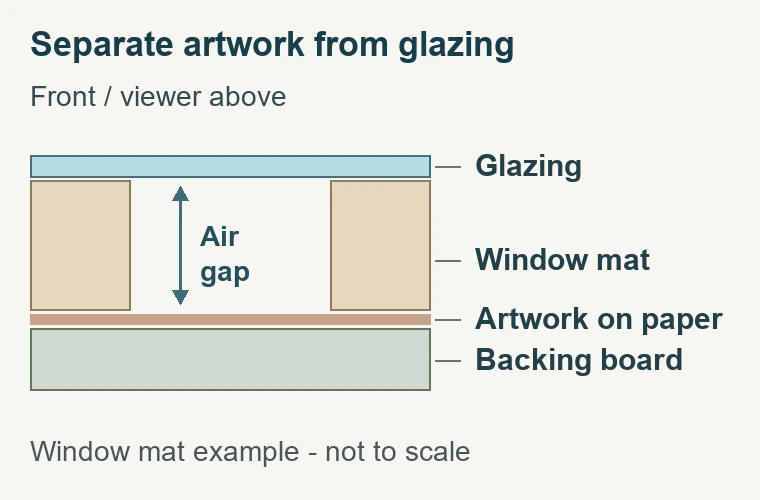
- Confirm the receiving dimensions using the current designer or the actual frame opening. The outside moulding size is not the glazing size. A mat may enlarge the package beyond the image window, and a replacement pane should be measured from the receiving arrangement rather than estimated from a front photograph. Follow the supplier's allowance convention instead of applying an extra adjustment from another ordering system.
- Record the actual thickness and include it with mats, spacers, artwork support, and backing in the depth check. A pane with excellent viewing properties still needs a package that fits the usable rabbet. Check where the completed backing sits and which retainers suit that position. Do not use hardware pressure to force a bowed or over-deep stack into a shallow moulding.
- Consider the completed weight and handling requirements of glass. An anti-reflective coating does not change every physical property into one associated with acrylic. For an awkward size or frequent transport, assess the material and frame together. The small sample display does not establish a maximum safe size, a frame capacity, or a shipping method for every finished work.
Protect the coating during preparation
- Prepare a clean padded work area and keep grit and loose tools away from the pane. Support the glass for its actual dimensions. Inspect the cut size and condition before fitting. A damaged edge or incorrect pane should be addressed before the artwork is placed beneath it. Do not assume a final frame lip makes any pre-existing damage irrelevant.
- Use the exact product's orientation and cleaning instructions. Keep its identity with the pane until fitting is complete. Do not test coating identity by scratching the viewing area or rubbing it aggressively. If the supplied product cannot be identified reliably, ask the supplier before assembling it into the frame. A documented answer is more useful than an improvised test that changes the surface.
- Clean with the recommended materials and method already described for the product. Inspect both faces under useful light before closing the package. If a mark remains, distinguish dirt, residue, reflection, and physical damage before changing the treatment. A more abrasive or chemically aggressive method can create a new problem rather than solve the original one.
Finish with a repeatable inspection and record
- Verify the product, size, thickness, and any required side orientation.
- Confirm the planned mat or spacer gap and artwork support.
- Inspect the clean assembled front for image detail, reflections, dust, and alignment.
- Retain the package without distorting it and inspect again.
- Check the completed picture in the intended room.
- Keep the product and care information with the order record.
If the final room reflection differs from the sample, compare the lighting angle, picture height, and viewing position before concluding that the supplied glass is wrong. Also verify the product identity and cleanliness. That sequence separates a changed display condition from a specification error. Photograph the whole arrangement and the troublesome view if you need to discuss it with the supplier.
For future servicing, preserve the exact product name rather than only the description non-glare or museum-type glass. Those informal terms can conceal meaningful differences. Include the verified UV requirement, if any, and the contact-material specifications of the rest of the package. A replacement can then reproduce the intended features rather than only resemble the original pane's reflection.
The successful choice is a pane whose coated viewing behavior solves the actual reflection concern while meeting the specified protection, fitting, and care requirements. It is not a universal promise of invisible glass. Test the particular artwork and room so the final order has a clear and reviewable purpose.
Made in the USA
Handcrafted by American framing experts
Family Owned
Serving customers for over 40 years
Premium Shipping
Professionally packaged for safe delivery
Ready to Hang
Hardware included with all frames
Framing Specialists
Over 40 years of custom framing experience