Ok

Ok

What is the question
Cancel
PICTURE FRAMES
 CUSTOM PICTURE FRAMES
Design Your Framing Package Online!
Add Mats, Glass & Acrylic, Mounting Board And More.




Search
☰

My Account
Log In
Favorites
Saved Designs
Shopping Cart
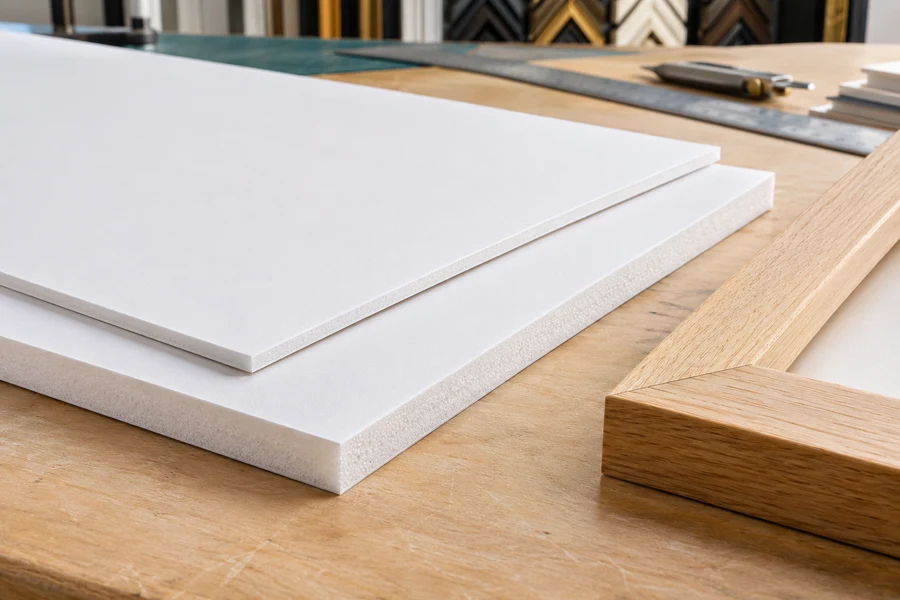
Regular foam board supports a framing package from behind. Compare thickness and stiffness, verify the material specification, and check the complete rabbet depth.
Watch: Regular Foam Board for Picture Framing
Understand paper-faced foam board
Regular foam board has paper faces over a lightweight, compressible foam core. It can be dented or crushed; secure fitting does not mean squeezing the backing as hard as possible.
Regular foam board and acid-free foam board are separate material choices. For fine art, important photographs, or irreplaceable work, compare the verified acid-free option rather than assuming a white surface proves suitability.
Compare regular foam-board thickness and material
| Choice | Physical consideration | Check separately |
|---|---|---|
| 1/8-inch regular foam core | Uses less package depth. | Adequate support at the required dimensions. |
| 3/16-inch regular foam core | The thicker, more rigid option; uses another 1/16 inch. | Complete package fit and retainer position. |
| Acid-free foam core | A separately specified material choice. | Use verified properties where the artwork requires them. |
| Any backing | Supports the package from behind. | Artwork attachment and hanging hardware remain separate. |
Choose thickness by stiffness and available space
Compare 1/8-inch and 3/16-inch sheets. The thicker sheet gives more rigidity but uses an additional 1/16 inch of package depth. The thinner sheet can be useful when usable rabbet space is limited.
- Measure the complete package, not the backing alone.
- Compare that thickness with the frame's usable rabbet.
- Check that the chosen backing provides enough support for the actual dimensions.
- Confirm that the retaining hardware can hold the package without crushing the board.
Fit the board as part of the package
Use the required outside backing dimensions, seat it flat behind the artwork, and check alignment before closing the tabs or other retainers. Backing supports the package; it does not automatically attach the artwork or replace an appropriate mounting method.
Compare 1/8-inch regular foam core and 3/16-inch regular foam core, or use the full backing-board guide.
Decide what the backing must support
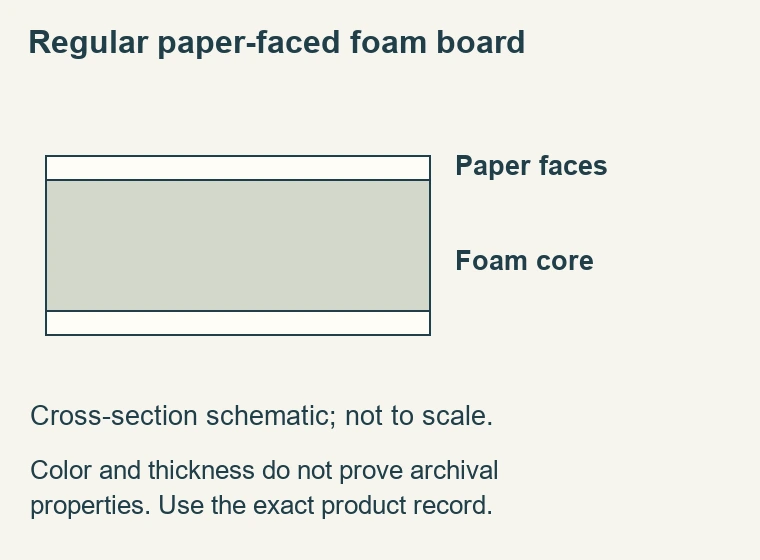
- Regular foam board is a lightweight backing construction with paper faces and a foam center. Check the face, edge, and condition to identify its physical construction. It is useful to distinguish that construction from thin matboard, corrugated cardboard, and a harder-faced mounting board. Boards can share a color or thickness while behaving differently as supports. Identify the actual material before choosing it for a framing package.
- Check backing size and support separately. They do not establish one maximum frame size or load for every regular foam board. The support needed depends on the dimensions, artwork, mounting arrangement, frame, and retaining method. Assess the full sheet in the intended construction rather than assuming that the behavior of a small hand-held sample certifies a much larger unsupported panel.
- Separate backing from mounting. A backing sheet closes and supports the package from behind. The artwork still needs an appropriate way to be located and supported. Choosing foam board does not automatically mean the image should be bonded permanently to it, and it does not specify an adhesive. Decide the mounting method for the artwork and its future needs before treating the board as a complete solution.
Compare a replacement with the current package
When the old backing is removed, note its measured thickness and where it sat relative to the frame back. Compare that with the proposed replacement before transferring the artwork. A thicker sheet can change the retainer position; a thinner one can change support. Inspect the old board's edges to distinguish ordinary handling damage from evidence that it was forced into an undersized opening. Do not copy a poor fit automatically. Record the corrected size and material with the frame so the next replacement starts from a verified arrangement rather than the dimensions of a damaged sheet.
Compare the two thicknesses as a fit decision
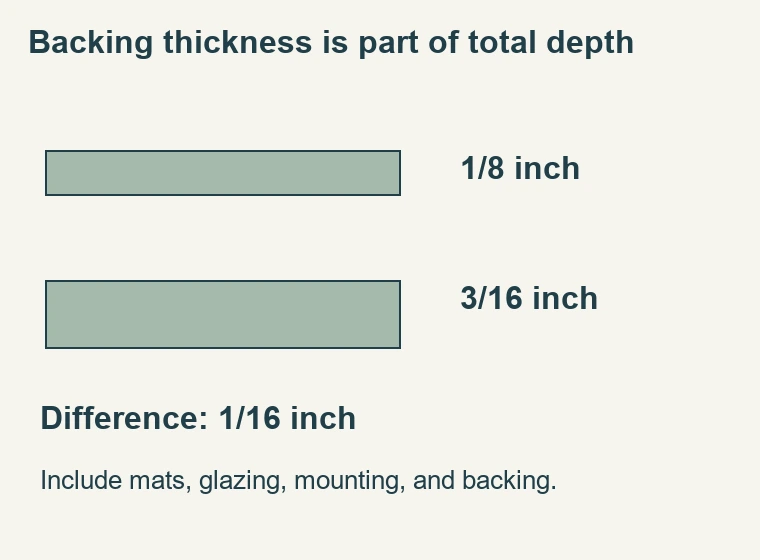
- The 1/8-inch and 3/16-inch options differ by 1/16 inch. That difference can matter in a shallow frame. The thicker sheet uses more of the available rabbet while providing the more rigid of the two options. Do not select thickness from a preference for the larger number alone. Compare support and available space together so the final package is neither inadequately supported nor too deep to retain correctly.
- List the thickness of the intended glazing, mats, spacers, artwork support, and backing. Compare their arrangement with the usable recess in the frame. Overall external moulding height is a different measurement. A tall decorative profile may still leave limited room where the backing must sit. Use the actual frame geometry rather than assuming that an impressive-looking moulding accommodates every board choice.
- If a thinner backing is being considered to preserve a chosen frame, check whether it still supports the required dimensions. If it does not, revise the frame or package rather than accepting an unsuitable support. Conversely, a thicker board should not be squeezed into place with points or clips. The retaining arrangement should hold a properly seated package, not compress an over-deep stack until it appears to fit.
Measure the package outside size
- The backing usually relates to the full framing package rather than only the visible image window. A mat can enlarge that package substantially. Measure the dimensions required by the frame or follow the designer's convention. The outside moulding dimensions are not the backing dimensions. Keep width, height, thickness, and material identity together in the order so an otherwise correct sheet is not supplied for the wrong reference rectangle.
- For an existing frame, inspect the actual receiving opening and the condition of the old backing. Do not copy a distorted or poorly fitting old sheet without checking why it looks that way. Confirm whether the replacement should have the same dimensions and thickness. A different mat or glazing arrangement may have changed the available depth since the original package was assembled.
- If cutting is required, use the board supplier's and tool manufacturer's instructions. Material identification does not establish a universal cutting setup. Work on a suitable protected surface with the artwork removed from the cutting area. Check the finished dimensions and edge condition before introducing the sheet into the frame. A ragged or crushed edge can interfere with seating and create debris in the package.
Verify material suitability independently of its appearance
- Regular foam board should not be assigned an archival claim merely because its faces are white. Regular and specifically acid-free options must remain distinct. For artwork requiring that property, choose the verified material rather than trying to infer chemistry from a clean surface. The same principle applies when reusing an offcut whose original packaging and specification are no longer known.
- Check other contact materials as well. An archival mat in front of the work does not automatically establish the properties of a regular backing behind it. Likewise, a conservation glazing choice does not change the backing specification. Treat these components as a package and verify each material relevant to the artwork's contact and support requirements.
- Consider future removal when choosing the artwork attachment. A board that physically supports a print may still be used with an unsuitable adhesive. Do not treat the word mounting as a complete method description. Record whether the work is hinged, otherwise attached, or supported through a particular arrangement, and use the corresponding materials and instructions. The backing's rigidity and its attachment chemistry are separate decisions.
Seat the board without crushing it
- Inspect the clean board for dents, damaged corners, and an unintended curve.
- Confirm the artwork is positioned and attached as planned.
- Place the backing behind the package and check that it seats evenly.
- Look for an edge catching the frame or a folded component trapped underneath.
- Use retaining hardware suited to the final back position.
- Inspect the front again after the package is retained.
The foam core can be compressed. Extra pressure is not evidence of a better fit. If a retainer dents the board or the package changes shape while being secured, inspect the setup. The cause may be an over-deep stack, an unsuitable retainer, poor seating, or excessive force. Identify it rather than adding more pressure to hold an already distorted arrangement.
A back that looks flat does not automatically mean the artwork remains correctly aligned. Support the frame while inspecting the front for a shifted mat, altered crop, visible spacer, or trapped debris. Complete that check before adding a paper dust cover. The cover finishes the appearance of the back but does not make loose retainers or an unsuitable support dependable.
Assess a backing when the frame is reopened
- Inspect the board for crushed edges, handling damage, and changes that affect its seating. Do not reuse it automatically simply because it still fills the opening. If the artwork, glazing, mat layers, or mounting arrangement changes, review the required dimensions and thickness again. A backing selected for an older package may no longer provide the intended fit.
- Keep the material record with any reusable offcut. A white paper-faced board can be difficult to identify later by casual inspection. If its specification is unknown, do not relabel it as acid-free because the new project needs that property. Obtain the appropriate verified material. That small recordkeeping step avoids turning a physical resemblance into an unsupported artwork-contact claim.
- Compare alternatives by the requirement that remains unresolved. If the issue is contact suitability, compare the acid-free board. If depth is limited, compare the actual thinner construction and its support. If the project needs a harder-faced rigid mounting panel, assess that material separately rather than expecting regular foam board to acquire the same behavior through tighter fitting.
- The final choice should document the board construction, thickness, outside size, artwork attachment, and retaining arrangement. Review what the order includes before closing the purchase: backing alone does not supply glazing, mats, mounting materials, or hanging hardware. The completed package should show how that material serves the particular artwork rather than rely on a generic preference for foam core.
Made in the USA
Handcrafted by American framing experts
Family Owned
Serving customers for over 40 years
Premium Shipping
Professionally packaged for safe delivery
Ready to Hang
Hardware included with all frames
Framing Specialists
Over 40 years of custom framing experience